
Let AI Handle Credit Policy Enforcement and Free Your RMs
This is Article 5 of 6 in the Q-Lana Customer Centricity series. Credit policy enforcement is AI's most valuable role in lending. A six-check gatekeeper run shows how it settles compliance before committee and makes overrides safe.

Credit policy enforcement is where AI adds the most value in a bank, more than advice does. Done properly, it does not police relationship managers (RMs). It frees them to spend more time with clients. The AI debate in lending usually focuses on the wrong role. Vendors promise advice and boards worry about replacement. Credit officers ask whether a model will make decisions they must defend to a regulator. The more useful role is less glamorous.
AI works best as a silent compliance officer, quality controller and process coach. This article sets out four principles, a worked gatekeeper run, and what changes as a result.
Four Principles of Credit Policy Enforcement

Four principles make enforcement trustworthy, and none of them is optional.
i. Policy alignment
Every recommendation is validated against policy and risk appetite before it reaches a committee. Sector caps, concentration ratios, tenor limits, coverage and gearing covenants, minimum returns, collateral coverage, legal compliance. Each check returns a result with the rule it applied.
ii. Explainability
Every recommendation carries its trail: the data points that triggered it, the policy rule or appetite clause applied, and the expected effect on risk and profitability. A recommendation nobody can explain is a recommendation nobody should act on, whatever its accuracy.
iii. Human oversight
Nothing executes without confirmation. Every override is logged with its justification and its approval chain. The override is a feature, not a failure.
iv. Continuous learning
Decisions and outcomes feed back. Toolkits that work gain confidence. Rules that get overridden repeatedly get flagged for review rather than defended. An institution that never revisits an over-ridden rule is not learning, it is arguing.
What the checks cover
Policy alignment covers sector caps, concentration ratios and tenor limits. It also covers coverage and gearing covenants, minimum returns, collateral coverage and legal compliance. Each check is tied to a clause in the risk appetite framework. A recommendation nobody can explain should not be acted on, however accurate it is.
The override is important
An override is a feature of the system, not a failure. Each one records where an experienced person saw something the rule did not. A bank that never revisits a frequently overridden rule is not learning. It is simply repeating the argument.
A Gatekeeper Run on One Facility
Principles alone persuade few people, so here is a facility going through the checks. The client is the construction subcontractor from the previous article. The proposal combines a working capital facility with an equipment loan.
Sector cap and concentration. Pass.
Facility tenor, six years against a seven-year maximum. Pass.
Debt service coverage covenant, projected at 1.15 against a policy minimum of 1.20. Warn. The named remedy is to extend the tenor or reprice.
Minimum RAROC, 17.2 per cent against an 18 per cent floor. Warn. The named remedy is cross-sell or additional collateral.
Collateral coverage, 1.30 times against a 1.25 minimum. Pass.
Single-buyer concentration, 34 per cent against a 30 per cent cap. Fail. The named remedy is a diversification covenant.
Six checks, three outcomes, and every one of them arrives with a cited threshold and a specific action rather than a red flag.
What changes in the credit committee
The committee no longer spends time on whether the file complies. That question is settled and evidenced before the meeting. The discussion moves to the single failure and the two warnings that need a decision. For this facility, that means agreeing to the diversification covenant and choosing between a longer tenor and repricing. That is the work a credit committee exists to do.
How Credit Policy Enforcement Frees The RM
The intuition runs the other way, so it is worth being explicit.
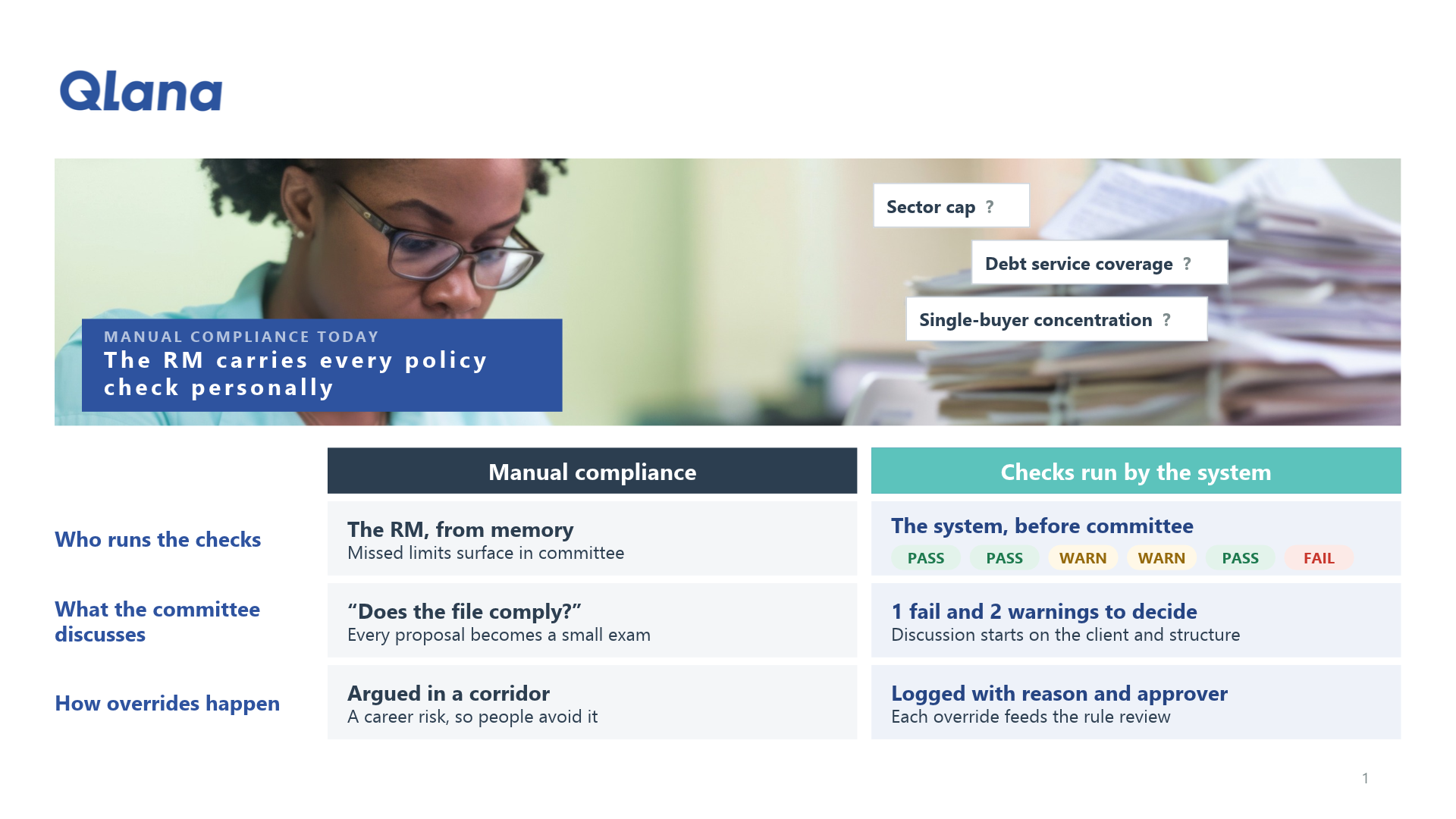
The burden of manual compliance
In a manual process, the RM carries compliance personally. Either they remember the sector cap, or they find out in committee. Every proposal becomes a small exam. The anxiety it creates eats into time that should go to the client.
Moving the burden into the system
When the system runs the checks, the RM stops rehearsing policy and starts using judgement. They arrive at committee with the checks done and the exceptions already named. The discussion starts where it should, on the client and the structure.
Overrides become safe
There is a quieter benefit. When compliance is automatic, disagreeing with a rule becomes safe. An override logged with a reason is a professional act. An override argued informally in a corridor is a career risk, so people avoid it. The bank then loses the judgment it hired them for.
What Credit Policy Enforcement Does to Risk Culture
Enforcement changes risk culture in three ways, and none of them is about control.
i. Consistency across the book
The same rules applied the same way to every file, regardless of which relationship manager brought it or how persuasive they are in a room.
ii. A shortened feedback loop
Because every recommendation and every override is recorded against an outcome, the institution can see which rules are working. A threshold that gets overridden forty times in a quarter is telling you something about the threshold, not about the people overriding it.
iii. Faster onboarding
A new credit officer inherits the institution's accumulated policy reasoning rather than learning it by making mistakes for two years.
Where the boundary sits
When someone asks whether the machine is deciding, the answer stays the same. AI enforces the credit methodology and never replaces it. Every output links to its source data and the rule it applied. People shape, override and make the final decision.
Building This in Your Team
The Q-Lana Financial Skills Campus is launching Customer-Centric SME and Corporate Finance, a class for RMs and credit teams. It covers the diagnosis-first conversation and the structuring decisions that follow from it. It also shows how to keep both inside the risk appetite framework. Practitioners who carry an SME book teach it on your own files.
Next in This Series
The final article in this series covers how the whole model is measured and governed. It shows how to make it permanent, not just something that worked well in one pod for a year.
Run a Facility Through the Gatekeeper
Q-Lana · Customer Centricity
The Light-Touch Approval Gatekeeper
Run a facility through the six checks. Each returns a cited threshold and a named remedy, not a red flag. Nudge any value to watch a Pass turn into a Warn or a Fail, and the committee's agenda change with it.
Facility under review
Construction subcontractor · combined working-capital and equipment structure, carried from the discovery and the toolkit composer.Gatekeeper verdict
The Q-Lana white paper Customer Centricity in SME and Corporate Lending sets out the full enforcement model. It includes all four principles and the complete gatekeeper run.
All Articles in This Series
- Customer Centricity in SME Lending Is a Risk Strategy
- SME Lending Operating Model Built on Solution Pods
- Solution Toolkits Settle the Risk Before the Client Asks
- Client Discovery in Ten Minutes Changes the Credit File
- Let AI Handle Credit Policy Enforcement and Free Your RMs (this article)
- RM Incentives Decide Whether Customer Centricity Sticks
Follow Q-Lana
One short email a week on credit risk, lending and impact finance, free. Or browse more guides in the Q-Lana Knowledge Center.
Get Q-Lana Weekly
One short email a week on credit risk, lending and impact finance, free. Or browse more guides in the Q-Lana Knowledge Center.