Risk Sharing Concept
This is the eleventh and final article in Q-Lana's Digital Transformation and Business Strategy Series on how financial institutions combine customer-centricity, risk management, data, and partnerships into a modern strategy. It closes the series on how risk-sharing extends capital and trust.
Risk sharing enables financial institutions to work with funding providers to reduce loan exposure. Serving SMEs effectively also requires strong customer relationships, specialized understanding, and effective risk management.
An essential part of the business model is the ability to share risks with investors. To approach these sources of risk capital, the financial institution shall work with one or more funding providers or fund managers on the concept of risk sharing. A fund manager can launch targeted open-ended and closed-ended investment funds to reduce the financial institution's loan exposure risk, while also advising on the proper structuring and pricing of assets earmarked for selling.
Introducing the SME Lending Fund
In this final chapter of the blog series on digital transformation and business strategy, we introduce the concept of the SME Lending Fund, which we have developed over the past years at Q-Lana, and are planning to launch together with our own asset management subsidiary, Q-Lana Investment Advisors.
Providing financial services to SMEs is among the most interesting and most challenging business areas for traditional financial institutions. Financial services for SME clients require specific understanding of the way those companies conduct business, the entrepreneur's personality, strengths, and weaknesses.
Providing Financial Services for SME Clients is for the Largest Part Relationship Banking
It can take several years to build an understanding of the client and the business potential. A good SME relationship manager in a financial institution has gained the trust of the entrepreneur and of the management of the company. The relationship manager fully understands the business of the client and the personality of the people involved.
Successful financial institutions in the SME space build up this understanding and knowledge through a strong focus on the interaction with the client. Entrepreneurs on the other hand value both solid and modern financial services as well as a trustful relationship with their financial institution. They prefer to rely on a financial institution as a long-term business partner, based on trust and understanding. The local presence and the proximity to the SMEs puts local financial institutions in an advantageous position when it comes to monitoring and collecting on loans.
Linking Back to Business Strategy
The entire Business Strategy presented in this blog series is based on this concept of customer centricity and proprietary knowledge in the assessment and management of risk.
SME Loans Attract Investors
Loans to local SMEs are an attractive asset class, to which domestic and international investors usually have no access. Lending requirements of established banks are thorough, including enforceable collateral. Interest rates are attractive, and SME loans usually do not correlate with other established asset classes. Currently, investors have limited access to these loans: international and development financial institutions often lend to larger banks for balance sheet lending, which doesn't create direct exposure to SME loans because local banks absorb defaults. Investing in international funds, including traditional impact investment funds, does not provide sufficient yield, since the operating costs of such funds are high.
The SME Lending Fund Solution
The SME Lending Fund addresses these issues and offers an attractive, low-cost solution that combines the strengths oflocal banks and investors. In this model, local financial institutions are the competent finance partners to SMEs, providing both funding and financial advisory, leveraging their in-depth knowledge about SMEs, accumulated by the local banks.
How the Fund Works
The lack of risk capital of local financial institutions is addressed through a risk-sharing mechanism through which the SME Lending Fund, and ultimately the investors, take actual default risk on the underlying loans, reducing regulatory capital requirements for local banks and providing a solution to the gap in term funding:
- By collecting funds from international and domestic investors and investing them in loan participations originated by local financial institutions, investors have direct access to the credit risk, while leaving origination and monitoring to the local institution.
- By engaging in a risk-sharing mechanism through arrangements like silent participations or club transactions, the interest in monitoring the loans and collecting outstanding amounts is aligned between the financial institutions and the investor.
General Structure of the SME Lending Fund
The general structure of the SME Lending Fund is shown in the following description. The structure is based on a complex version that allows for fundraising in international markets.
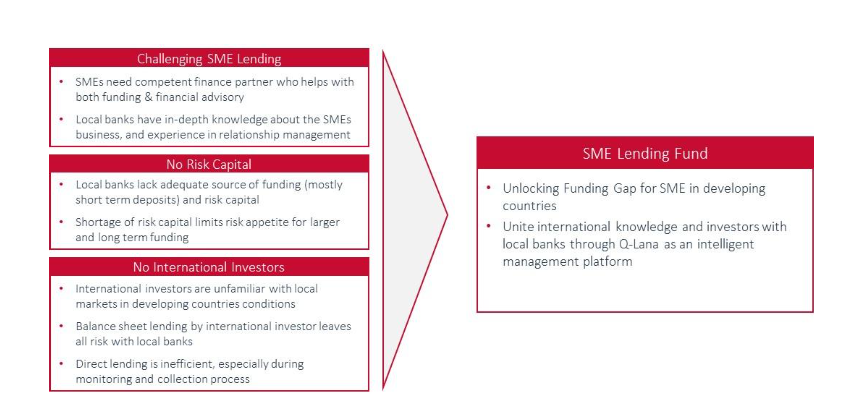
Challenging SME Lending: SMEs need a competent finance partner who helps with both funding & financial advisory; local banks have in-depth knowledge about the SME's business and experience in relationship management.
No Risk Capital: Local banks lack an adequate source of funding (mostly short-term deposits) and risk capital; shortage of risk capital limits risk appetite for larger and long-term funding.
No International Investors: International investors are unfamiliar with local markets in developing countries' conditions; balance sheet lending by international investors leaves all risk with local banks; direct lending is inefficient, especially during monitoring and collection process.
→ SME Lending Fund: Unlocking Funding Gap for SME in developing countries; unites international knowledge and investors with local banks through Q-Lana as an intelligent management platform.)
Wrapping Up the Series
We have now come to the end of this series on Digital Transformation and Business Strategy. Over the past chapters, we explored how financial institutions can combine customer-centricity, structured risk management, data analytics, and innovative partnerships to strengthen their business models.
Risk sharing, as we discussed here, is a vital element that connects institutions with investors and creates resilience in SME lending. At Q-Lana, we are committed to helping financial institutions put these strategies into practice.
Thank you for following along with us in this series. We look forward to continuing the conversation and supporting you on your digital transformation journey.
About This Series
This article is part of Q-Lana's Digital Transformation and Business Strategy series, exploring how financial institutions combine customer-centricity, structured risk management, data analytics, and strategic partnerships into a modern business model.
The complete series includes:
- Digital Transformation With Q-Lana
- Steps to Prepare for Digital Transformation
- Are You Ready for Digital Transformation?
- Let's Develop a Business Strategy
- Customer Centricity
- Risk Management
- Data Analytics
- Risk Appetite and Relationship Pricing: Part 1
- Risk Appetite and Relationship Pricing: Part 2
- The Q-Lana Platform, and this article.
Continue the Conversation
Talk to the team. Senior-to-senior. No sales call.
Subscribe to Q-Lana Weekly. One newsletter, five lenses, free, no paywall.
Open the Fund Management solution. See how the platform operationalizes this discipline.