Banks have long carried the reputation of being archaic and resistant to change. When I started my career in 1989 at a financial institution in Germany, I vividly remember a speech by Ulrich Cartellieri, then a member of Deutsche Bank’s management board. He called banks the “steel industry of the 1990s”—a warning that without digital transformation, the sector risked becoming outdated and irrelevant.
At the time, this message was barely taken seriously. Even as financial crises unfolded in different regions and on a global scale, banking business models remained largely untouched. Yes, products evolved, technologies improved, and workplaces modernized, but the fundamentals of how banks operated hardly changed.
Then Came Fintechs
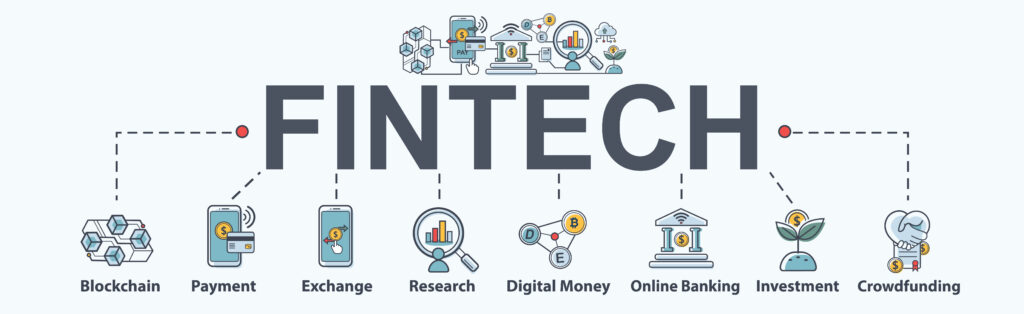
Over the past decade, fintech companies positioned themselves as disruptors threatening to displace traditional banks. They were powered by new technology, bold claims, and often extremely cheap funding. But many of these firms underestimated the true role of financial services in the economy. Today, several of those fintechs have vanished as quickly as they rose to prominence.
Digital Transformation in Banking Takes Center Stage
Despite this turbulence, the reality is that banking now sits at the very center of digital innovation. Customers expect seamless, personalized services. The demand for smarter, more impactful financial solutions is stronger than ever. The time for digital transformation in banking has arrived.
Q-Lana’s Experience in Driving Digital Transformation
At Q-Lana, our mission is to help financial institutions evolve into stronger, more impactful organizations. We do this by combining technology and advisory services. Our approach emphasizes knowledge-based lending and, importantly, the human side of digitalization. Technology alone is not the answer—implementation, training, and strategy are what bring real results.
One of our key goals is to demystify complex concepts around digital transformation. In any new field, buzzwords often create confusion.
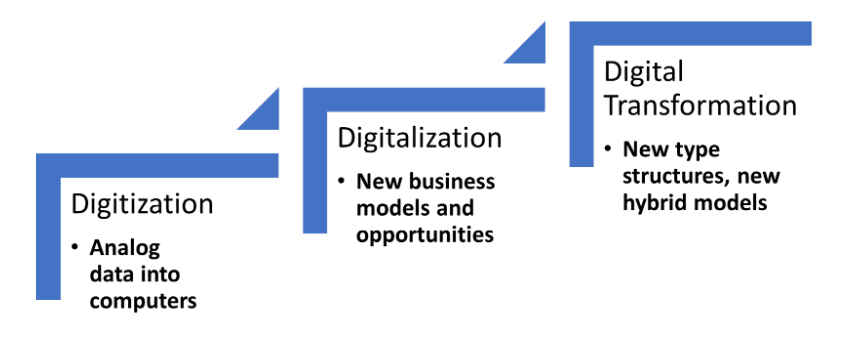
Let Us clarify three terms that are frequently mixed up:
- Digitization
- Digitalization
- Digital Transformation
1. Digitization: The First Step Toward Digital Transformation
Digitization means converting analog information, like paper files, voice recordings, or pictures, into digital form so that computers can store and process it. Most financial institutions have already gone through decades of digitization by implementing core banking systems (CBS) or management information systems (MIS). These tools streamline operations, reduce turnaround time, and improve portfolio quality by enabling systematic data collection and analysis.
2. Digitalization: Expanding Services Through Digital Channels
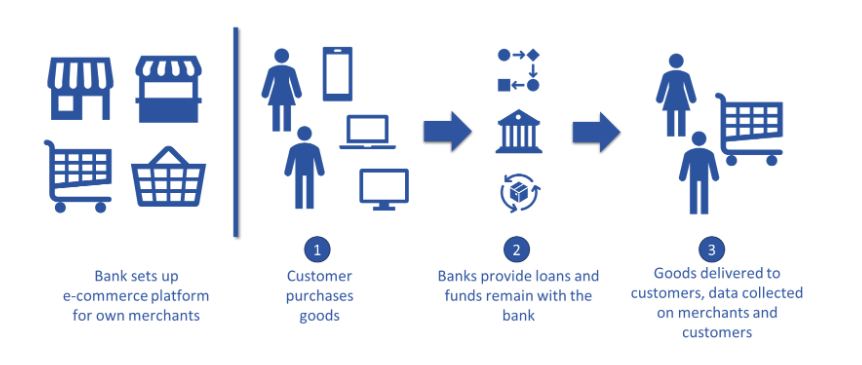
Digitalization goes a step further. It refers to delivering financial services through digital channels, either directly or in partnership with others. Digital Financial Services (DFS) often connect banks with e-commerce platforms, payment service providers (PSPs), or mobile network operators.
Consider this example: a bank with strong retail operations sets up an e-commerce platform for its MSME clients. MSMEs can open online shops and accept digital payments, while individual customers can make purchases with consumer loans directly linked to the platform. This setup not only strengthens the relationship between the bank’s MSME and retail customers but also expands the bank’s overall activity.
3. Digital Transformation: Reshaping the Future of Banking
Finally, digital transformation is the broadest and most far-reaching concept. It’s not just about adopting tools or channels; it’s about reshaping the very nature of financial institutions. It will change how banks operate, what business lines they focus on, and how they interact with the wider ecosystem.
We already see this happening through open banking, where financial institutions provide their infrastructure as a service to other companies—e-commerce platforms, PSPs, insurers, remittance providers, or even cryptocurrency exchanges. Regulatory frameworks in many countries are pushing institutions further in this direction.
Within the next decade, most financial institutions will have no choice but to embrace digital transformation. They will need to open their systems, partner with fintechs and hybrid firms, and adapt to new regulations.
What’s Next in the Series
Preparing for the Digital Transformation Journey
This article concludes the first chapter of our Digital Transformation and Business Strategy Blog Series. In the next section, we will discuss how financial institutions can prepare for their own digital transformation journey.