
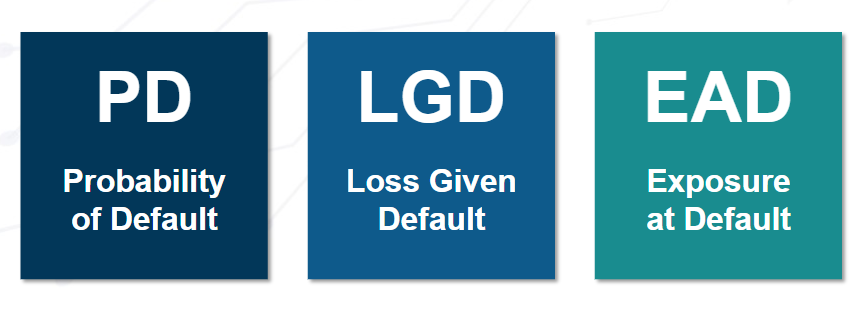
Quantifying credit risk is a cornerstone of effective risk management for financial institutions. By breaking credit risk into measurable components, institutions gain the ability to assess, price, and manage their exposures with greater precision. This chapter introduces the three foundational variables used to quantify credit risk: Probability of Default (PD), Loss Given Default (LGD), and Exposure at Default (EAD). Together, they enable institutions to model potential credit losses and make informed decisions about risk-return trade-offs.
Quantifying Credit Risk
Quantifying Credit Risk Using Probability of Default (PD)
The Probability of Default (PD) is a fundamental concept in credit risk management. It represents the likelihood that a borrower will fail to meet their financial obligations, such as repaying a loan, within a specific time frame—typically one year. Expressed as a percentage, the PD provides an estimate of the risk of default for individual loans or an entire portfolio.
What PD Tells You About Credit Risk
For example, if a loan has a PD of 5%, it means there is a 5% chance that the borrower will default within the next 12 months. Similarly, in a portfolio of 20 loans with the same PD, one would expect, on average, one default over the same period. While this is a simplified view, it illustrates how the PD helps quantify the likelihood of non-payment and enables institutions to make informed decisions.
How Do You Estimate PD?
Determining the PD involves predictive models that assess the creditworthiness of a borrower. These models are often based on historical data, financial performance indicators, and borrower-specific factors. Institutions use tools such as credit scoring and rating systems to classify borrowers into risk categories. For instance, high-quality borrowers with stable financials may have a low PD, while riskier borrowers with weaker credit profiles will likely have a higher PD. While PD values provide a probabilistic measure of risk, they are often calibrated to reflect real-world default rates observed over time.
Quantifying Credit Risk Through Loss Given Default (LGD)
The Loss Given Default (LGD) is a critical measure in credit risk management. It represents the portion of a lender’s exposure that is likely to be lost if a borrower defaults, after accounting for recoveries from collateral or other mitigation mechanisms. LGD is expressed as a percentage of the total exposure at the time of default. For example, if a lender has an outstanding loan of $10,000 and expects to recover $6,000 from collateral, the LGD is 40%.
Factors That Influence LGD
Several factors influence the LGD, and understanding these is essential for accurately estimating potential losses:
- Collateral
The type, quality, and liquidity of collateral play a significant role in determining LGD. High-quality, liquid collateral, such as cash or government securities, typically reduces LGD as it can be quickly and easily converted into cash. On the other hand, illiquid or complex collateral, such as real estate located in foreign jurisdictions, may not reduce the LGD. These assets often have valuation uncertainties or involve legal challenges in enforcement, making recoveries slower and less predictable. - Market Conditions
Economic conditions can significantly affect the LGD. During economic downturns, collateral values often decline, leading to higher losses. For example, in a recession, real estate prices may drop, reducing the recoverable amount from a property-backed loan. Similarly, in volatile markets, the liquidation value of inventory or equipment may be lower than expected, increasing the LGD. - Recovery Time
The time required to recover funds also impacts LGD. Lengthy enforcement or legal proceedings can erode the value of recoveries due to holding costs, depreciation, or other expenses. For example, a lender attempting to enforce claims on real estate in a foreign country might face delays due to legal disputes, during which the value of the property may deteriorate.
LGD is inversely related to the Recovery Rate, which represents the percentage of exposure recovered after default, or expressed as an equation:
LGD = 1 – Recovery Rate
For instance, if the LGD is 40%, the Recovery Rate would be 60%, indicating that 60% of the exposure is expected to be recovered. Understanding LGD helps lenders prepare for loss scenarios and assess the effectiveness of risk mitigation strategies such as collateral management and legal recovery processes.
Quantifying Credit Risk Using Exposure at Default (EAD)
Exposure at Default (EAD) represents the outstanding loan amount or credit exposure expected at the time a borrower defaults. In essence, it quantifies the portion of the loan or credit facility that is likely to be utilized when a default occurs. EAD is a critical component in assessing potential credit losses and determining the capital requirements needed to mitigate risk. The value of EAD varies depending on the type of credit product and when in its lifecycle the default occurs.
What EAD Represents
For term loans, which have fixed repayment schedules, EAD typically decreases over time as the loan is amortized. For example, halfway through a loan’s tenure, the EAD is generally around half of the original loan amount, assuming consistent repayment patterns.
For revolving credit facilities, such as credit lines or overdrafts, EAD is usually assumed to be the full limit of the facility. This is because borrowers often maximize their utilization of such facilities before defaulting, leading to a higher exposure at the point of default.
Several factors can influence EAD, including the specific contractual terms of the loan. Features, such as prepayment clauses or financial covenants can help limit the exposure and reduce potential losses.
Key Drivers of EAD Estimation
Accurately estimating EAD requires careful analysis of borrower behavior, particularly in areas such as:
- Utilization patterns: How borrowers typically use revolving credit facilities, including trends in drawing down available limits.
- Prepayment trends: The frequency and timing of early repayments for term loans.
- Timing of default: The point within the credit facility’s lifecycle when defaults are most likely to occur.
EAD in the Context of Credit Loss Estimation
EAD, along with Probability of Default (PD) and Loss Given Default (LGD), forms the foundation for estimating potential credit losses. Each of these variables contributes a distinct perspective to the overall risk assessment:
- PD quantifies the likelihood of default.
- LGD measures the extent of losses when a default happens.
- EAD captures the size of the exposure at risk during a default.
PD, LGD, and EAD variables are vital for measuring both expected and unexpected losses. This concept is essential for a credit risk manager who desires to set capital buffers, price loans effectively, and maintain portfolio resilience.
In the next chapter, we explore how these inputs feed into more advanced metrics, thus equipping you to make sharper, risk-informed decisions.