
Understanding why most SME lending data fails is critical for any institution that wants to make faster, more confident, and more consistent credit decisions. At first glance, it may appear that banks lack sufficient information. However, the ability to use that information effectively.
In reality, banks do not suffer from a lack of data. Instead, they suffer from unusable data.
Financial statements exist.
Relationship manager notes exist.
Collateral files exist.
Credit committee memos exist.
And yet, when a real credit decision has to be made, quickly, confidently, and consistently, most institutions still struggle to answer basic questions:
If, at this point, the answer is “not really,” then the problem is not technology. Rather, the problem is data discipline.
The SME Data Illusion
Over the past decade, banks have invested heavily in digitization. More systems. More data fields. More dashboards. More reports. Yet SME lending outcomes have not improved proportionally.
Why is that?
Simply put, data volume is mistaken for data quality. As a result, most SME lenders operate with:
Fragmented client information across systems
Multiple versions of the “same” financials
RM insights trapped in emails or free-text notes
Credit decisions that cannot be reconstructed once the deal is approved
Early warning signals that appear only after problems surface
Consequently, this creates a dangerous illusion: the institution feels informed, while it is actually guessing. And when guessing is embedded into workflows, no amount of automation will fix it.
Data Is Not an IT Topic: It Is a Decision Topic
One of the most persistent mistakes in SME banking is treating data management as an IT or reporting exercise. In fact, it is neither. Data management is about decision quality.
Every SME loan decision depends on a combination of:
Quantitative data (financials, repayment behavior, exposure)
Qualitative judgment (business model, management quality, market dynamics)
Policy constraints (risk appetite, limits, pricing rules)
When these inputs are incomplete, inconsistent, or poorly structured, the decision is compromised, regardless of how experienced the people involved may be.
Good SME lenders do not rely on heroic individual judgment. They rely on repeatable, evidence-based decisions. That is only possible when data is managed deliberately.
What “Good” Actually Looks Like
High-performing SME lenders do not necessarily have more data than others. They have better-organized data.
In practice, “good” data management enables:
Decision-Ready Credit Packages
Relationship managers and analysts are not assembling information from scratch. Instead, core data is already structured, validated, and available, reducing preparation time and errors.
Reproducible Decisions
Every approval, exception, or decline can be traced back to its inputs. The reasoning is visible, consistent, and auditable.
Early Warning Visibility
Behavioral signals, covenant breaches, and qualitative concerns surface early, before arrears or restructurings force action.
A True 360° Client View
All exposures, facilities, interactions, and performance indicators are visible in one place, not across five systems and ten spreadsheets.
Ultimately, this is not about perfection. It is about trust. If decision-makers trust the data, they move faster and with more confidence. If they don’t, every process slows down.
From Administrative Burden to Strategic Asset
When data is poorly managed, it feels like overhead:
Extra forms
Extra controls
Extra reporting
Extra frustration
By contrast, when data is well managed, it becomes a strategic asset:
Faster credit cycles
Sharper risk differentiation
Better pricing discipline
Stronger client relationships
Scalable growth without loss of control
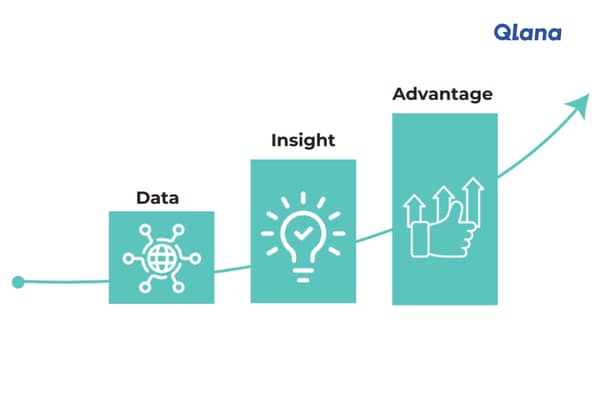
This is the point where data stops being something the institution has and becomes something the institution uses. At the same time, this is also the moment where AI becomes possible.
Why AI Comes Last – Not First
Today, artificial Intelligence is transforming SME lending, but only for institutions that have done the foundational work.
To be clear, AI does not fix:
Inconsistent data
Missing ownership
Undefined risk logic
Poor governance
Instead, AI amplifies whatever is already there.
If the data foundation is weak, AI simply automates confusion, faster. Conversely, if the data foundation is strong, AI becomes a powerful accelerator:
Summarizing verified information
Detecting early risk patterns
Enforcing policy and risk appetite consistently
Supporting relationship managers with preparation and insight
AI is not a shortcut. It is a force multiplier, and only after discipline is in place.
Setting the Stage for Real Data Management
Effective SME data management requires deliberate choices:
Defining which data domains actually matter
Designing a minimum viable architecture that connects existing systems
Establishing governance that people follow, not policies they ignore
Enforcing a small number of critical data-quality rules
Capturing qualitative knowledge before it disappears
These are not technical decisions. They are leadership decisions. And postponing them is one of the most expensive mistakes an SME lender can make.
About This Series
This article is part of Q-Lana’s four part Data Management series on how modern SME lenders turn fragmented information into decision intelligence.
The complete framework, includes the articles on
- Concepts of good data management,
- The eight critical data domains,
- Minimum viable data architecture, and
- Data governance, quality, and knowledge management,
The full content in a more detailed version is available in Q-Lana’s Data & Knowledge Management Whitepaper.