
In SME and corporate lending, most risks do not begin in spreadsheets. They begin in conversations, in the moment when a client hesitates while explaining a cash-flow situation, or when a growth story sounds confident on the surface but the underlying timelines are vague, or when margins look stable on paper while working capital quietly tightens quarter by quarter. These signals appear months before they show up in financial statements. And yet, in many banks, the most consequential interaction in the lending process, the conversation between a relationship manager and their client, remains largely unstructured.
Consequently, that is a missed opportunity.
Customer centricity becomes real not simply when better products are offered, but rather when better questions are asked, consistently, deliberately, and with purpose.
Why Most Client Conversations Fail to Create Insight
Relationship managers speak with clients constantly. They meet in person, exchange calls, respond to emails, and fill notebooks with observations.

However, activity is not insight. In many institutions, client conversations suffer from three structural weaknesses:
They are unstructured
The flow of the conversation depends on the personal style and experience of the individual RM. Some topics get covered carefully; others are skipped entirely, not out of negligence but simply because there is no consistent frame of reference to ensure they come up.They are transactional
They focus on the immediate request (“I need a loan”) rather than on the underlying business drivers that explain why the request is being made and what a genuinely appropriate response would look like.They are poorly captured
Valuable qualitative observations disappear into narrative notes, informal emails, or memory. Early risk signals that were visible in conversation are lost before they can inform credit decisions or portfolio monitoring.
The result is that early warning capacity atrophies, diagnostic insight accumulates nowhere, and customer centricity ends up depending on the memory and intuition of whoever happened to be in the room.
Discovery as Diagnosis – Not Data Collection
The RM Discovery Script reframes the client conversation. It is not a checklist, a sales pitch, or an interrogation.
It is a structured diagnostic conversation, designed to understand how the client’s business actually works, and where it is under stress. The objective is not to collect more information. It is to identify the real problem that needs solving.
This shift is subtle, but powerful. Instead of asking: “How much financing do you need?” the RM explores: “What is happening in the business that creates this need?”
Instead of documenting products discussed, the RM captures business dynamics, constraints, and risks. This is where customer centricity moves from intent to execution.
The Ten-Minute Structure That Changes Everything
The Discovery Script is deliberately designed to be short enough to be used consistently, structured enough to make outputs comparable across the portfolio, and flexible enough to leave room for professional judgment. In practice, it can be completed or refreshed in around ten minutes. It is organized around five core diagnostic lenses:
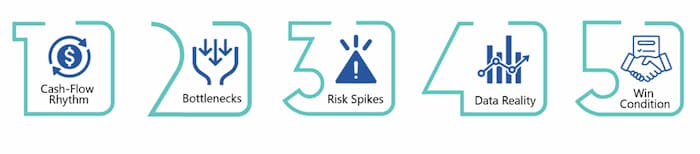
1. Business Model & Value Creation
The conversation begins with the business model itself: how the client creates value, what drives revenues and margins, and where in the operating cycle value is generated versus where it is consumed. This grounds the discussion in economic reality rather than financial ratios. Many risks that later appear in numbers are already visible at this level, if the questions are asked.
2. Cash-Flow Dynamics & Volatility
the timing relationship between inflows and outflows, the degree of seasonality, the dependence on a small number of customers or suppliers, and the vulnerability to delayed payment. This lens regularly reveals the true explanation behind a financing request. What presents as a need for growth capital often turns out, on closer examination, to be a cash-flow smoothing problem with a very different optimal structure.
3. Growth, Investment & Capacity Constraints
Growth is rarely linear, and the financing needs it creates are not always obvious from the headline numbers. This part of the conversation addresses planned expansion, investment timelines, capacity constraints, and the funding gaps that growth creates before it generates returns. Critically, it distinguishes between growth that strengthens the business and growth that quietly increases risk exposure.
4. Risk Exposures & Shock Sensitivity
FX exposure, input price volatility, regulatory dependencies, customer concentration. This is not about predicting crises. It is about developing a calibrated sense of how fragile or resilient the business would be under stress. Clients often reveal more in this part of the conversation than they intend to, when the questions are framed well.
5. Management Behavior & Decision Patterns
Finally, the conversation touches on:
How management responds to pressure
Decision-making discipline
Transparency with stakeholders
Learning from past setbacks
This is not about judgment or opinion. It is about observing patterns of behavior. For experienced RMs, this lens often carries the strongest early-warning signals.
Why Structure Improves, Not Replaces, Judgment
The most common concern relationship managers raise about structured scripts is that they reduce autonomy. The experience of banks that have implemented them suggests the opposite. A structured discovery format removes the cognitive burden of trying to remember what to ask while simultaneously paying attention to the answers. It ensures that critical topics are never inadvertently skipped. And it creates a reliable baseline that makes case comparison across the portfolio possible in a way that purely narrative approaches cannot.
What this frees up is the judgment that experienced RMs actually want to exercise: interpreting what a client says, identifying inconsistencies between what is stated and what the numbers suggest, deciding when to probe deeper and when to let something rest. The script does not tell relationship managers what to think. It ensures they never stop thinking about the right things.
Turning Conversation into Institutional Insight
A discovery conversation only creates lasting value if its insights are captured in a form that can be used beyond the immediate interaction. That requires structure at the point of capture. Rather than open-ended narrative notes, the Discovery Script is designed to produce observations organized by lens, flags against probable problem archetypes, connections between qualitative observations and available data indicators, and a concise diagnostic summary that informs everything downstream.
Over time, this enables comparison across clients, trend detection at portfolio level, and a form of institutional learning that is genuinely evidence-based rather than anecdotal. The bank begins to know things it previously could only intuit, and that knowledge compounds.
The Role of AI: Preparation, Consistency, Follow-Up
AI plays a supporting, not dominant, role in the Discovery Script.
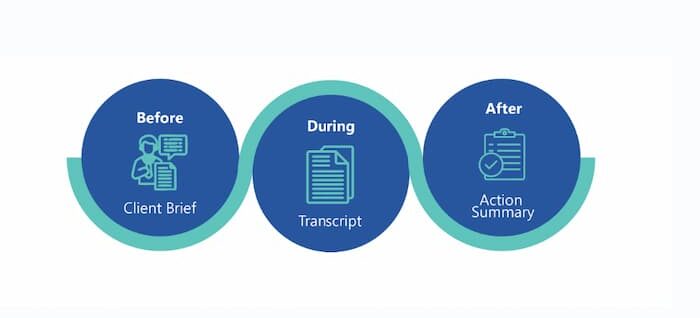
Used well, it can prepare the relationship manager before the conversation by surfacing relevant data and flagging inconsistencies or gaps. After the conversation, it can help structure notes consistently, check alignment with risk appetite parameters, and identify follow-up actions that might otherwise be missed.
But the quality of what AI can process depends entirely on the quality of what went into the conversation. The questions asked, the listening that shaped them, and the judgment applied to what was heard, these remain human contributions that AI supports rather than substitutes for. AI makes discipline scalable. It does not replace the understanding that comes from a well-conducted conversation.
AI assists. Humans decide.
The quality of insight still depends on:
The questions asked
The listening skills of the RM
The judgment applied
AI makes discipline scalable; it does not replace human understanding.
Why This Changes Risk Outcomes
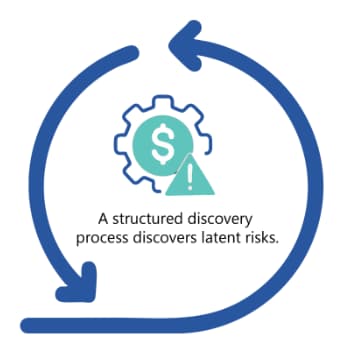 Structured discovery conversations change risk management in three ways:
Earlier detection
Problems are identified before they crystallize in financials.Better structuring
Solutions are aligned with the real business issue, not just symptoms.Stronger monitoring
Follow-up focuses on relevant indicators, not generic covenants.
Customer centricity, when practiced this way, does not increase risk. Instead, it reduces surprise.
From Conversation to System
The RM Discovery Script is not an isolated tool. Rather, it connects directly to:
Problem Archetypes
Solution Toolkits
Risk Appetite checks
Portfolio monitoring
Thus, it creates a closed loop: conversation → diagnosis → solution → monitoring → learning. Customer centricity becomes a system, not a personality trait.
Setting the Stage for the Next Step
This article focused on the moment of interaction: how structured conversations turn dialogue into diagnosis.
In the next article, we will look at what happens next:
how AI enforces methodology across the customer journey, transparently, explainably, and with humans firmly in control.
Closing Thought
Customer centricity does not start with platforms or product catalogues. It starts with conversations designed to reveal what is actually happening in a client’s business. When those conversations are conducted well, and their insights captured properly, SME lending becomes proactive rather than reactive, and that is where most of the risk management value actually lives.
.Setting the Stage for the Series
This article is part of Q-Lana’s six part Customer centricity on how modern SME lenders turn fragmented information into decision intelligence.
The complete framework, includes the articles on:
How customer centricity becomes scalable without reorganizing the bank
The RM discovery script
Artificial intelligence must enforce discipline, not replace judgement, and
How customer centricity becomes measurable, enforced and self sustaining