
Most banks describe themselves as customer-centric. Yet when asked what that actually means in practice, the answers are often vague: better service, faster turnaround times, more relationship managers, more products.
These are not wrong objectives, but they miss the point.
In fact, customer centricity is not about how friendly a bank appears. Instead, it is about how effectively it helps clients run stable businesses while at the same time protecting its own risk appetite.
Specifically, in SME and corporate lending, customer centricity is not a soft concept. Rather, it is a risk and performance strategy.
Why Product-Centric Lending Is Reaching Its Limits
For decades, lending has been organized around products. Overdrafts, term loans, trade finance, FX lines, guarantees, each with its own policy, pricing logic, and internal workflow. Products are easy to catalogue, straightforward to control, and simple to report on. They fit neatly into the structures banks have built for themselves.

Yet, SMEs do not experience their financial lives in products. They experience cash-flow volatility and the anxiety that comes with it. They experience working-capital pressure that constrains their ability to grow. They experience currency exposure, seasonality, and shocks that threaten survival. When they come to a bank, they are not shopping for a product. They are looking for help with a problem.
When banks approach these situations with a product-first mindset, the results are predictable. Solutions arrive fragmented. Risks are addressed after they have already materialized. Clients feel sold to rather than understood. And from the bank’s side, the consequences are equally costly: slow credit decisions, repeated restructurings, rising portfolio volatility, and the gradual erosion of relationships into pure price competition. Product-centric lending is not just frustrating for clients. It is inefficient and risky for the institution
Customer Centricity Reframed: From Selling to Solving
The shift that customer centricity requires is not complicated to describe, though it takes real discipline to execute. Instead of beginning with a product and finding a client who needs it, customer-centric lending begins with the client’s problem and works forward to a solution. The question is no longer “Which product fits this client?” It is “Which problem is this client trying to solve, and how can we support that safely?”
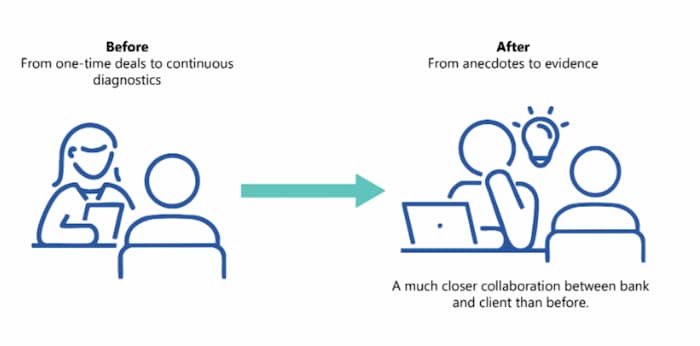
The practical difference is substantial. When a client struggling with seasonal cash-flow volatility is met with a revolving credit facility, the product may fit technically without addressing the underlying dynamics at all. When the same client is met with a diagnostic conversation that explores the timing and severity of their cash-flow gaps, the resulting solution can be structured to actually match the business reality. That distinction, between a product that technically qualifies and a solution that genuinely fits, is what customer centricity is about.
This approach also demands discipline. Solving a client’s problem does not mean saying yes to everything. It means understanding the problem well enough to structure a response that serves both the client’s needs and the bank’s risk framework. Customer centricity, at its best, is structured empathy: empathy guided by data, policy, and professional judgment.
Why Customer Centricity Improves Risk Outcomes
There is often a misconception that customer-centric approaches are “softer” on risk. However, in reality, the opposite is true. Specifically, customer-centric lending improves risk management because it:
Forces earlier engagement with underlying business drivers
Aligns financing structures with real cash-flow dynamics
Reduces reliance on reactive restructurings
Strengthens mutual transparency between bank and client
These are not marginal improvements. They are the difference between reactive portfolio management and genuinely proactive risk oversight.
The mechanism is straightforward. Customer-centric lending forces earlier engagement with the underlying drivers of a client’s business. It aligns financing structures with actual cash-flow dynamics rather than generic maturities. It reduces reliance on late-stage restructurings that are expensive for both parties. And it builds the kind of transparency between bank and client that makes early warning signals visible rather than hidden.
Clients whose financing genuinely fits their business are more likely to perform as expected. They are more likely to remain solvent through difficult periods. And they are more likely to remain loyal over time. Customer centricity is not about absorbing more risk in service of relationship quality. It is about taking better risk, more precisely understood, more appropriately structured, and more proactively managed.
Customer Centricity as an Operating Philosophy
The reason customer centricity so often fails is not that banks disagree with the idea. Most banks genuinely believe in it. The reason it fails is that it is treated as a philosophy rather than a methodology: something to aspire to, to train on, to mention in annual reports, but not something to embed in the day-to-day mechanics of how lending actually happens.
That gap between aspiration and execution is where customer centricity quietly dies. An isolated front-office initiative, however well-intentioned, cannot change how credit decisions are prepared or how risk appetite is applied. A training programme that ends when the cohort returns to their desks does not build institutional capability. And a branding exercise that describes the bank as client-focused without changing any underlying processes creates nothing except cynicism.
Real customer centricity requires a methodology: shared definitions of common client problems, structured diagnostic conversations, repeatable solution patterns aligned with risk appetite, and governance that reinforces consistency over time. Without that structure, performance depends on individual talent and goodwill. With it, customer centricity becomes something the institution can actually build on
Aligning Client Success and Bank Profitability
There is a deeper logic to customer centricity that is worth being explicit about. At its core, the model aims to align two objectives that are often treated as being in tension: client stability and bank profitability. In practice, these objectives are far more connected than they appear.
Clients with stable cash flows, appropriate financing structures, and transparent relationships with their bank are more likely to repay on time, grow sustainably, and remain long-term partners. Banks that help clients achieve those outcomes benefit from lower credit losses, more stable earnings, better capital efficiency, and stronger relationship economics. The alignment is not accidental. It is structural.
Customer centricity, understood this way, is not altruism. It is strategic self-interest, executed with discipline. The banks that internalize this and act on it consistently are the ones that will build genuinely differentiated SME franchises over the next decade.
The Role of Data, Technology, and Human Judgment
Modern customer-centric lending would not be possible without the combination of better data, better technology, and experienced human judgment. But their respective roles matter.
Data provides evidence: financial trends, behavioral signals, exposure patterns
Technology organizes and prepares this information at scale
Human judgment interprets context, nuance, and intent in ways that no algorithm currently replicates.
The failure mode comes when any one of these elements is allowed to dominate the others. Data without judgment becomes mechanical. Judgment without data becomes anecdotal. Technology without methodology becomes noise. The goal is not automation for its own sake. It is augmentation: helping relationship managers and credit teams prepare better, see patterns earlier, and direct their expertise where it actually makes a difference. That balance is a recurring theme in this series
Why This Matters Now
The case for customer-centric lending is not theoretical, and it is not timeless. It is urgent. SME and corporate clients increasingly operate in environments defined by higher volatility, tighter margins, more complex supply chains, and greater exposure to external shocks. At the same time, banks face rising regulatory scrutiny, capital constraints, and competitive pressure from non-bank lenders who are not burdened by the same structural inertia.
In this context, traditional product-centric models face a compounding disadvantage. Banks that continue to treat lending as a sequence of isolated product decisions will find it progressively harder to differentiate, manage risk proactively, and serve clients in ways that generate genuine loyalty. Customer centricity, properly engineered, is one of the most credible responses to that challenge.
Q-Lana is built around the principle of loan management that integrates client data, risk, and relationship intelligence in one place.