Data Governance, Data Quality & Knowledge Management
This is the final article in Q-Lana’s four-part Data Management Series, covering data governance, quality, and knowledge management for modern SME lending.

Every SME lender agrees on one thing: good data matters. Yet when it comes to data governance, quality, and knowledge management, enthusiasm fades quickly. Governance frameworks are approved. Policies are written. Committees are formed.
And then, quietly, discipline erodes. Not because people don't care. But because governance is often designed in a way that no one can realistically follow.
This final article in the Data Management series addresses the most uncomfortable truth in SME lending transformation: Most institutions give up on data discipline just before it starts delivering real value.
Why Data Governance Fails in Practice
Data governance rarely fails because the concept is wrong. It fails because the execution ignores human behavior.

Common patterns include:
- Overly complex governance models
- Dozens of data-quality rules, none enforced consistently
- Ownership assigned to "committees" instead of people
- Governance processes detached from daily work
- Metrics that track activity instead of outcomes
The result is predictable:
- Business teams bypass controls to get work done
- Data quality deteriorates quietly
- Trust in reports erodes
- Decisions revert to intuition and spreadsheets
At that point, governance is seen as bureaucracy, not enablement. And once trust is lost, rebuilding it becomes exponentially harder.
Governance Is About Behavior, Not Documents
Effective data governance does not start with policies. It starts with behavior. Every time a relationship manager enters client data, every time an analyst updates financials, every time a credit officer records a decision, governance is either reinforced, or weakened.

That is why successful institutions treat governance as:
- A daily discipline
- Embedded into workflows
- With visible ownership and consequences
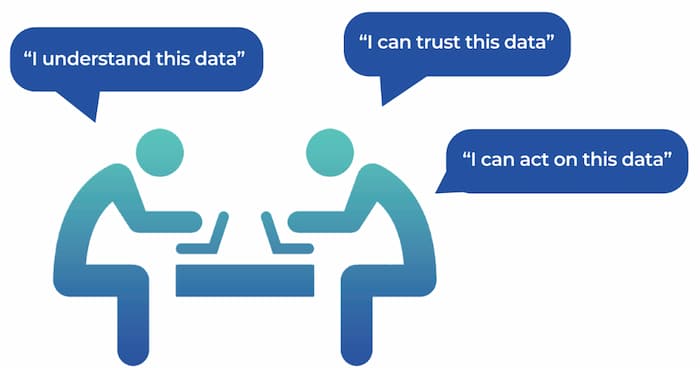
The goal of governance is not control for its own sake. It is trust. When people trust the data, they use it. When they don't, governance becomes irrelevant.
Ownership in the Business, Not in IT
One of the most damaging misconceptions is that data governance belongs to IT. It doesn't. IT enables platforms.
The business owns the data.
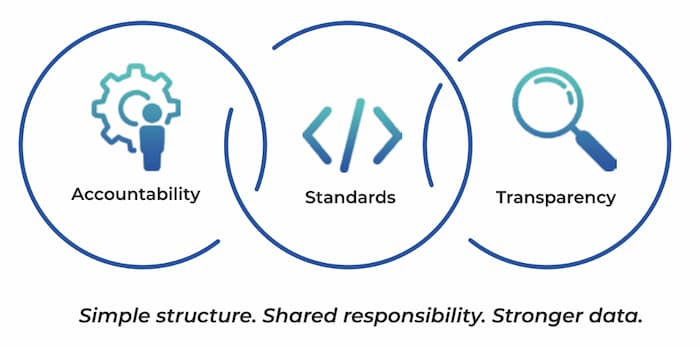
Effective governance assigns:
- Data Owners – senior business leaders accountable for a data domain
- Data Stewards – operational experts responsible for quality and definitions
- Clear escalation paths when standards are not met
Ownership must be:
- Explicit
- Visible
- Linked to decision-making authority
When ownership is vague, data quality becomes "someone else's problem." When ownership is clear, behavior changes. This is a leadership choice, not a technical one.
Data Quality: Small Rules, Ruthlessly Enforced
Many institutions sabotage themselves by defining too many data-quality rules.
- Hundreds of checks
- Complex validation logic
- Dashboards no one looks at
High-performing SME lenders do the opposite. They define a small number of non-negotiable rules – and enforce them relentlessly.
Typical examples include:
- Completeness: Core fields (legal form, sector, UBO ownership, risk grade, collateral type) must never be blank at approval
- Validity: Dates must make sense. Interest rates must fall within approved risk appetite boundaries
- Accuracy: Ownership data must match KYC documents. Collateral valuations must follow approved methods
- Consistency: One active master record per client. Exposure values aligned across systems
- Timeliness: Financials and covenants updated within defined intervals
These rules are simple by design. Their power lies in consistency, not sophistication. Data quality improves not when rules are clever, but when they are unavoidable.
Governance Must Be Visible and Measurable
If governance happens in the background, it will be ignored.
Effective institutions make data quality visible:
- Data-quality scorecards by domain
- Exception queues with named owners
- Clear deadlines for remediation
- Regular, short governance check-ins
Metrics matter, but only if they measure what counts. Useful KPIs include:
- % of mandatory fields complete
- Number of open data-quality exceptions
- Average resolution time
- % of credit memos auto-compiled from structured data
- Portfolio coverage with current financials
These metrics link governance directly to business outcomes: speed, reliability, and confidence in decisions.
Knowledge Management: The Hidden Edge
Even institutions with clean data often miss their greatest asset: what their people know.
SME lending is rich in tacit knowledge:
- Insights from site visits
- Impressions of management quality
- Early concerns that don't yet show in numbers
- Lessons from past approvals and failures
When this knowledge remains informal, it disappears:
- When staff rotate
- When portfolios are reassigned
- When decisions are revisited months later
Knowledge management turns experience into institutional memory.
This requires:
- Structured templates for RM notes and site visits
- Clear separation between facts and opinions
- Tagging of insights by client, sector, and topic
- Storage of credit committee rationales and exceptions
Over time, this creates a searchable repository of judgment, not just outcomes.
Where Data Meets Judgment
The real power of modern SME lending emerges at the intersection of:
- Structured data
- Professional judgment
Data validates intuition while judgment provides context data cannot capture.
When these two are integrated:
- Decisions become faster
- Confidence increases
- Learning compounds
This is also where AI becomes meaningful, not as a decision-maker, but as a multiplier of structured knowledge:
- Summarizing past decisions
- Surfacing recurring risk patterns
- Linking narrative insight to quantitative indicators
But AI only works when knowledge is captured deliberately. It cannot learn from what was never structured.
Why Institutions Give Up Too Early
Data governance and knowledge management rarely fail overnight.
They erode slowly:
- When exceptions are tolerated
- When ownership is unclear
- When quality issues are postponed
- When governance meetings are skipped
The irony is that this is usually the point where benefits are closest.
Institutions that persist through this phase experience:
- Measurable speed improvements
- Sharper risk differentiation
- Higher user trust
- Readiness for responsible AI
Those that give up return to spreadsheets, and start over again years later.
Discipline Is the Real Differentiator
Technology matters. Architecture matters. AI matters.
However, none of these substitutes for discipline. Data discipline reflects management discipline.
Governance discipline reflects leadership discipline. Institutions that accept this reality build SME lending businesses that:
- Scale without losing control
- Learn from every decision
- Partner with clients over the long term
The Series in Perspective
This article concludes Q-Lana's Data Management series. Across the four articles, we have shown that:
- Good SME lending starts with usable data
- It requires deliberate data domain design
- It is enabled by minimum viable architecture
- And sustained by governance, quality, and knowledge discipline
Together, these elements turn information into intelligence and intelligence into performance.
Final Thought
Successful SME finance is not improvised. It is engineered. Institutions that understand this do not chase technology trends. They build foundations, enforce discipline, and apply AI responsibly.
That is how SME lending becomes faster, safer, and more profitable for banks and for the businesses they serve.
About This Series
This article is part of Q-Lana's four-part Data Management series on how modern SME lenders turn fragmented information into decision intelligence.
The complete framework includes articles on:
- Concepts of good data management
- Minimum viable data architecture
- The eight critical data domains, and this article.
The full content in a more detailed version is available in Q-Lana's Data & Knowledge Management Whitepaper.
The Series in Perspective
This article concludes Q-Lana's Data Management series. Across the four articles: good SME lending starts with usable data, requires deliberate data domain design, is enabled by minimum viable architecture, and is sustained by governance, quality, and knowledge discipline. Together, these elements turn information into intelligence and intelligence into performance.
Continue the Conversation
Talk to the team. Senior-to-senior. No sales call.
Subscribe to Q-Lana Weekly. One newsletter, five lenses, free, no paywall.
Read the related white paper. Frameworks built to be deployed.