The Eight Critical Data Domains for SME Lenders
This is the second article in Q-Lana’s four-part Data Management Series, exploring the eight critical data domains for SME lending and how they support better credit decisions.

The Eight Critical Data Domains for SME Lenders begin with a simple truth: Every SME loan creates proprietary information. Not just financial statements and contracts, but insight: how a business really operates, how it reacts under stress, how management behaves, and how risk evolves.
The question is not whether this information exists. It does. The real question is whether the institution learns from it, or loses it.
In the first article of this series, we argued that most SME lenders do not suffer from a lack of data, but from unusable data. Information is fragmented, inconsistent, and poorly structured, undermining decision quality and trust.
In this article, we address the next critical step:
Defining the core data domains that every serious SME lender must deliberately own.
Without a clear data model, no architecture, governance framework, or AI initiative will ever work.
Data Domains Matter More Than Systems
One of the most common mistakes in SME lending transformation is starting with systems. Core banking. CRM. Credit workflow. Document management. Each is discussed in isolation, often replaced or upgraded independently.

However, systems come and go. Data logic must endure. If an institution has not defined what information it considers critical, how that information is structured, who owns it, and how it connects across the lending lifecycle, then, any system, old or new, will eventually recreate the same fragmentation.
Data domains provide the conceptual backbone of SME lending intelligence
They define what matters, independent of technology choices.
Institutions that define their data domains early build institutional memory, shorten learning curves, and create a compounding competitive advantage. Those that postpone this decision pay for it repeatedly, in rework, inconsistency, and lost insight.
Quantitative and Qualitative Data: Two Sides of the Same Coin
Before we look at the domains themselves, one principle must be clear:
Good SME lending requires both quantitative and qualitative data.
Financial ratios, repayment histories, and exposure numbers tell one part of the story, and relationship manager observations, site visit notes, and client interactions, tell another.
Most institutions are reasonably good at collecting numbers, even if inconsistently. They are far worse at capturing, structuring, and reusing context.
That context is not "soft data." It is often the earliest and most accurate indicator of risk or opportunity. A data domain model that ignores qualitative information is incomplete by design.
The Eight Critical Data Domains of SME Lenders
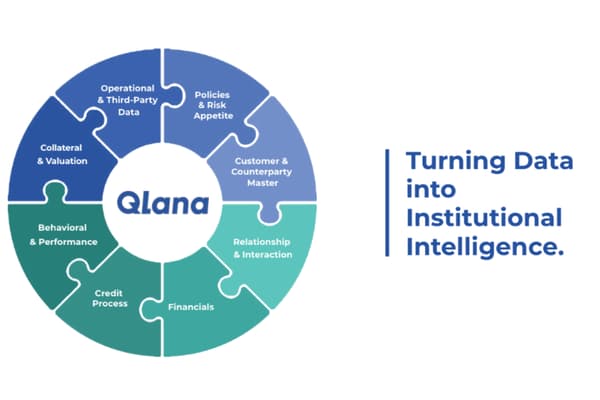
Based on extensive work with banks, funds, and financial institutions across markets, eight domains consistently form the minimum backbone of a serious SME lending operation.
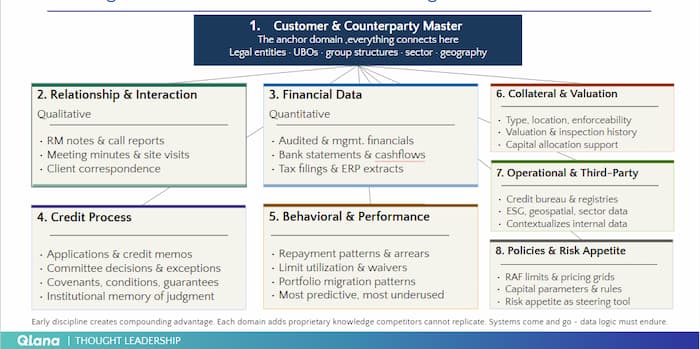
They are not theoretical, but practical, battle-tested, and mutually reinforcing.
Part 1 of the Eight Critical Data Domains
1. Customer & Counterparty Master
This is the anchor domain. Everything else connects here.
It includes legal entity data, ownership and ultimate beneficial owners (UBOs), group structures and related parties, sector classification (ISIC or equivalent), and geographic footprint.
Without a clean customer master, duplicates proliferate, group exposures remain hidden, and concentration risk becomes invisible
This domain establishes unique identifiers and data lineage. If this is weak, everything built on top of it is unstable.
2. Relationship & Interaction Data
This domain captures the human side of SME banking.
It includes RM call reports, meeting minutes, site visit notes, client correspondence, and internal assessments and observations
This is where most institutions lose critical knowledge. When relationship insight lives only in inboxes or free text, it disappears when people leave or portfolios change. Structured interaction data turns individual experience into institutional intelligence.
Over time, this domain becomes a powerful early-warning and opportunity-detection layer.
3. Financial Data
This is the quantitative backbone of credit assessment.
It includes audited and management financial statements, projections and budgets, bank statements and cash flow data, and tax filings or ERP extracts. The challenge here is not availability, but consistency over time.
Well-managed financial data allows trend analysis, automated ratio calculation, and comparability across clients and segments.
Poorly managed financial data forces analysts to start from zero with every review.
4. Credit Process Data
This domain documents how decisions are made.
It includes credit applications, credit analyses and memos, committee decisions, covenants, conditions, and guarantees, and approval rationales and exceptions. This is the institutional memory of credit judgment.
Without structured credit process data, decisions cannot be reproduced, exceptions cannot be analyzed, and learning is lost.
Strong institutions treat this domain as a strategic asset, not a compliance artifact.
Part 2 of the Eight Critical Data Domains
5. Behavioral & Performance Data
This domain captures what actually happens after approval. It includes repayment behavior, arrears and restructurings, limit utilization, waivers and breaches, and portfolio migration patterns.
Behavioral data is often the most predictive, and the most underused. Over time, this domain feeds early warning systems, PD calibration, differentiated pricing, and proactive portfolio management.
Ignoring behavioral data means repeating the same mistakes.
6. Collateral & Valuation Data
Collateral is not just a legal appendix. This domain includes collateral type and characteristics, location and enforceability, valuation and revaluation history, and inspection and monitoring records.
Poor collateral data leads to overestimated recovery values, weak provisioning, and surprises during enforcement.
Structured collateral data supports both risk management and capital allocation.
7. Operational & Third-Party Data
This domain enriches internal views with external context. It includes credit bureau information, business registries, ESG self-assessments, geospatial or sector data, and trade or invoice-level data (where relevant).
External data does not replace internal knowledge. It contextualizes it.
Institutions that integrate third-party data intelligently see patterns earlier and price risk more accurately.
8. Policies & Risk Appetite Data
This domain defines the boundaries of acceptable risk. It includes risk appetite limits, sector and obligor thresholds, pricing grids, capital allocation parameters, and policy rules and exceptions.
When this domain is not explicitly linked to exposures and decisions, risk appetite becomes theoretical. When it is integrated, it becomes a steering mechanism.
Early Discipline Creates a Compounding Advantage
Many institutions postpone formal data domain design until their SME portfolio has reached scale. That is a mistake.
Early discipline means:
- Cleaner data from day one
- Faster learning cycles
- Fewer legacy issues
- Easier automation later
Each loan, interaction, and decision adds to a growing proprietary knowledge base that competitors cannot easily replicate. This compounding effect is one of the most underappreciated advantages in SME lending.
Data Domains Are Leadership Decisions
Defining data domains is not a technical exercise. It requires strategic clarity, business ownership, and leadership commitment. Someone must decide what data matters, who owns it, and how it will be used. Without that clarity, even the best systems degrade over time.
Strong SME lenders understand this: data structure reflects management discipline.
About This Series
This article is part of Q-Lana's four-part Data Management series on how modern SME lenders turn fragmented information into decision intelligence.
The complete framework includes the articles on:
- Concepts of good data management
- Minimum viable data architecture
- Data governance, quality, and knowledge management, and this article.
The full content in a more detailed version is available in Q-Lana's Data & Knowledge Management Whitepaper.
Continue the Conversation
Talk to the team. Senior-to-senior. No sales call.
Subscribe to Q-Lana Weekly. One newsletter, five lenses, free, no paywall.
Read the related white paper. Frameworks built to be deployed.