
Artificial Intelligence
AI that strengthens decision-making across the full lending and investment lifecycle
Q-Lana’s AI strategy is built for one purpose: to strengthen institutional decision-making. We combine Q-Lana’s proprietary workflow data, embedded financial expertise, and practical risk methodology to help institutions turn operations into a continuously improving intelligence system. Q-Lana’s framework is explicitly designed around Data Management, Risk Management, and Customer Centricity as the three pillars of AI enablement.
Because Q-Lana sits at the center of the lending and asset management workflow, institutions using the platform accumulate rich proprietary data: financial statements, covenant tracking, repayment behavior, collateral information, sector intelligence, and RM observations. Over time, this becomes the foundation for AI models calibrated to the institution’s own borrower universe, not generic benchmarks.

Why Q-Lana’s AI Approach is Stronger
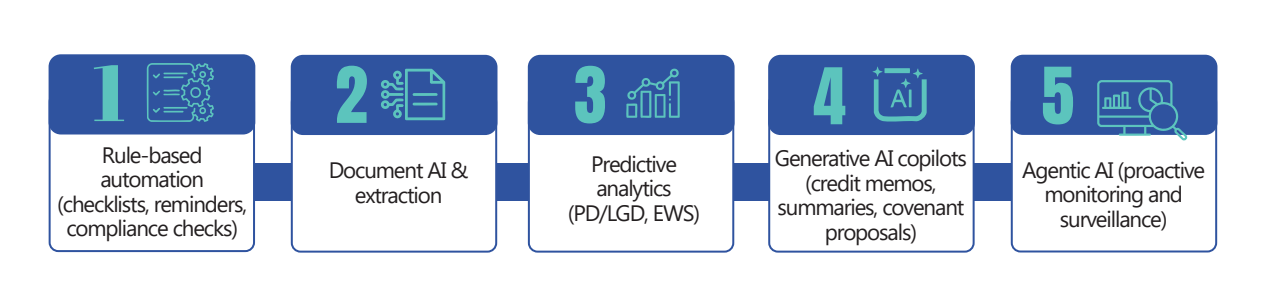
Q-Lana is not positioning AI as a stand-alone feature. We position AI as an institutional capability layer that improves process quality, consistency, speed, and governance across core workflows. The underlying strategy follows a practical maturity path, from rule-based automation to document AI, predictive analytics, copilots, and agentic monitoring, so institutions can adopt AI responsibly and in stages.
The Q-Lana AI Maturity Path
From Workflow Automation to Institutional Intelligence
Where AI Creates Value Across the Lifecycle
From Workflow Automation to Institutional Intelligence
AI helps institutions screen faster without lowering quality. Q-Lana’s framework includes examples such as a Prospect Triage Agent, KYC/AML Auto-Screen, Document Gap Detector, Sector Intelligence Brief, and a Pre-DD Risk Hypothesis Generator. These use cases support faster triage, better file completeness, and stronger first-meeting preparation for relationship managers.
This is where Q-Lana applies AI to reduce manual analytical workload while preserving analyst judgment. The framework includes Financial Statement Extraction, Credit Memo Copilot, Financial Model Stress Tester, ESG & Impact Risk Screening, Red Flag Detection, and Comparable Borrower Intelligence using the institution’s own proprietary portfolio history.
Q-Lana’s AI strategy strengthens one of the most important control gates: the period between approval and funding. Example use cases include a Conditions Register Tracker, Term Sheet Validation Agent, KYC/AML Automation Layer, Collateral Perfection Monitor, Readiness Scoring, and Legal/Tax DD Summarization.
Q-Lana treats covenants and monitoring as core risk management workflows, not administrative follow-up. The AI use cases include Covenant Design Advisor, Threshold Calibration, Automated Covenant Monitoring, Waiver Analysis, Covenant Predictive Power Tracking, plus monitoring-stage tools such as EWS AI Engine, Monitoring Copilot, Questionnaire Generator, Sentiment & News Monitor, and Watchlist Decision Support.
Q-Lana extends AI into valuation and portfolio management, where institutions need better accuracy, stronger governance, and board-ready insight. Example use cases include Automated Revaluation Triggers, Comparable Valuation Engine, Haircut Calibration Advisor, AI-assisted IFRS 9 / ECL support, and Collateral Registry Intelligence. At the portfolio level, Q-Lana includes Portfolio Intelligence Dashboards, Migration Matrix Analysis, Concentration Risk Monitoring, Vintage Analysis, Scenario Simulation, and Recovery Intelligence.
Q-Lana also extends AI into impact and ESG workflows, where institutions need to scale data collection and reporting without overwhelming staff or borrowers. The framework includes Impact KPI Extraction, Theory of Change Validation, ESG Risk Trajectory Tracking, Portfolio Impact Reporting, and Additionality Assessment Support.
The Q-Lana AI solution toolkit
Across these workflows, Q-Lana’s AI strategy organizes capabilities into a practical toolkit: Document AI, Copilot Agents, Predictive Analytics, Covenant Intelligence, Portfolio AI Engine, Compliance Automation, Client Intelligence, and Impact & ESG Tools. This makes it easier for institutions to adopt modular capabilities based on priorities, readiness, and governance requirements.

Built for Collaboration with Institutions
Q-Lana’s AI strategy is intentionally collaborative. We want to work with institutions to design and deliver extraordinary technical solutions that fit their business model, data reality, governance standards, and risk appetite. The framework explicitly supports institution-specific model calibration, AI implementation packages, and tailored deployment approaches, so AI strengthens decision quality in practice, not only in concept.
Responsible AI in Lending
This is the core Q-Lana principle for AI in lending and asset management. In regulated financial institutions, AI must strengthen accountability, not dilute it. Q-Lana’s approach is built on responsible adoption:
- Human-in-the-loop by design: AI drafts, humans decide
- Explainable outputs: every AI result is linked to source data in Q-Lana
- Full audit trail: from input data to AI-assisted output to final decision
- Model risk governance built in: inventory, validation, and fallback procedures
- Methodology first: AI accelerates and reinforces good process discipline, it does not bypass it
Book an AI Use-Case Workshop
Identify the highest-value AI opportunities across your lending or fund management workflow, mapped to your process, data, and control requirements.