Banks invest in new systems, roll out digital onboarding, experiment with AI pilots, and reorganize credit teams. Yet credit cycles remain slow, portfolio quality remains volatile, and relationship managers remain overloaded with manual work.
The uncomfortable truth is this:
Most SME lending transformations fail not because of technology, but because they are missing a coherent operating logic.
After more than three decades working with banks, funds, regulators, and boards across multiple markets, I have seen a consistent pattern. Institutions don’t struggle because SME lending is inherently risky. They struggle because they fail to integrate three fundamentals, and then hope that technology will compensate.
It won’t.
Successful SME finance rests on three non-negotiable components, tightly integrated and operationalized:
Data Management
Artificial Intelligence does not replace these pillars.
It only works once they are in place.
The Illusion of SME Lending Transformation
Why SME Lending Transformations Fail Before Technology Even Starts

Many SME lending initiatives start with the wrong question:
“Which system should we buy?”
The right question is far more uncomfortable:
“How do we actually make credit decisions and do we trust the information behind them?”
Without answering this, banks end up with:
Fragmented client data spread across systems
Credit decisions that rely on experience rather than evidence
Risk appetite statements that exist on paper but not in workflows
Relationship managers acting as data clerks instead of advisors
Technology layered on top of this does not transform anything. It only accelerates inconsistency.
Broader banking research finds that most digital transformation efforts fail not because of poor technology per se but because institutions underestimate organizational complexity, legacy technical debt, and the depth of operational change required, issues that are also central to SME lending transformation failures.
True transformation starts with discipline, and not dashboards.
Pillar 1: Data Management: From Information to Intelligence
Why SME Lending Transformations Fail Without Trusted Data

Good SME lending is impossible without good data.
Industry analysis also shows that traditional SME credit assessment remains slow and manual because lenders struggle to extract, structure, and reuse information from disparate documents and systems, undermining the ability to make evidence‑based decisions.
Yet most institutions confuse data volume with data quality.
Effective data management is not about collecting more information. It is about organizing what you already have so it can be trusted, reused, and scaled.
That requires:
When done correctly, data stops being an administrative burden and becomes a strategic asset.
Credit packages become decision-ready. Early warning signals become visible. Portfolio views become reliable.
This is also the moment where AI becomes possible, not before.
Pillar 2: Risk Appetite: Turning Risk into a Steering Tool
Why SME Lending Transformations Fail When Risk Appetite Stays on Paper

Every bank takes risk. However, very few banks steer it deliberately.
Risk appetite is often treated as a compliance document , which is reviewed annually, approved by the board, and ignored in daily decisions.
That is a mistake.
A well-designed Risk Appetite Framework (RAF) is the operating system of a lending institution. It translates strategy into boundaries and turns risk management from a defensive function into a performance lever.
At its core, this means:
Quantifying credit risk using PD, LGD, and EAD
Distinguishing clearly between Expected Loss (a cost) and Unexpected Loss (a capital issue)
Linking capital consumption to profitability through RAROC
Embedding limits, tolerances, and escalation rules directly into approval and monitoring workflows
When risk appetite is operationalized, something powerful happens:
Growth decisions become capital-aware
Pricing reflects real risk, not averages
Portfolio steering becomes proactive instead of reactive
Risk is no longer something to be avoided.
It becomes something to be used intentionally.
Pillar 3: Customer-Centric Banking: Beyond Products and Processes
Why SME Lending Transformations Fail Without Real Customer Design

Most banks claim to be customer-centric. However, few actually design their SME offering around how clients operate.
True customer centricity in SME banking is not about softer language or nicer onboarding screens. It is about structuring the bank around client jobs-to-be-done, not internal silos.
This requires:
Clear SME segmentation based on business reality, not size alone
Solution-oriented product bundles instead of isolated loans
Relationship managers supported by structured discovery scripts, not improvisation
Consistent handover from origination to monitoring
A 360° client view that integrates exposure, performance, covenants, and behavior
When customer centricity is real, it improves both sides of the balance sheet:
Clients receive relevant, timely solutions that meet their business needs
Banks benefit from stronger relationships, better data, and improved risk outcomes
This is not a soft concept, but a profitability strategy.
AI in Action: A Force Multiplier, Not a Shortcut
Why SME Lending Transformations Fail When AI Is Treated as a Shortcut

AI is transforming SME lending, but only for institutions that have done their homework.
According to independent research by business reporter, without properly structured and trusted data repositories, lenders cannot effectively apply analytics or AI to credit or portfolio decision, a constraint that persists in many traditional SME lending operations.
When data is clean, risk appetite is explicit, and processes are structured, AI becomes a powerful accelerator:
Automated extraction and structuring of financial data
Credit-ready summaries compiled from verified sources
Early warning systems that combine behavior, trends, and qualitative insight
RM copilots that support preparation, not replace judgment
Policy and risk-appetite checks enforced consistently and transparently
But AI does not invent discipline.
It enforces it.
Institutions that skip the foundations risk automating confusion, faster.
What “Good” Looks Like in Practice
When the three pillars work together, SME lending changes fundamentally:
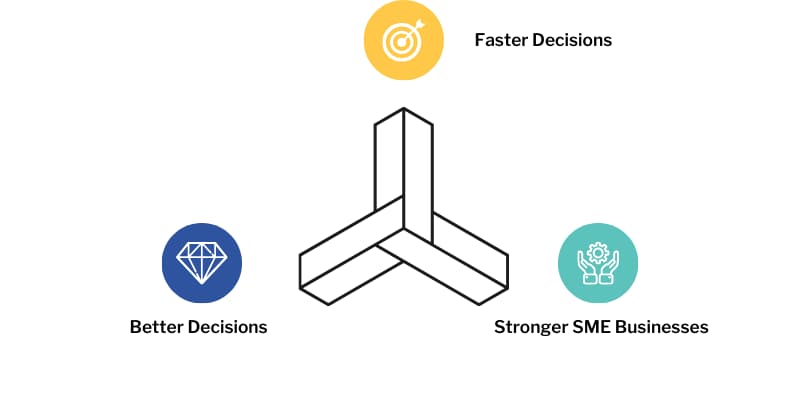
Faster decisions
Shorter credit cycles, fewer handoffs, decision-ready packages
Better decisions
Consistent risk inputs, clear capital logic, transparent governance
Stronger SME businesses
Relevant solutions, proactive monitoring, long-term relationships
This is not theoretical. It is operational. And it is achievable without massive system replacement — if the sequence is right.
Successful SME Finance is Not Improvised.
It is engineered.
Banks that get this right do not talk about digital transformation as an end goal.
They talk about decision quality, risk-aligned growth, and customer relevance.
The future of SME lending belongs to institutions that:
Treat data as an asset
Use risk appetite as a steering mechanism
Design banking around real client needs
Apply AI with discipline, not hype
That is the model Q-Lana was built to support, in technology, in training, and in execution.
Because in the end, SME lending is not about software.
It is about running a bank properly.