When it comes to efficiently managing risks, returns, and customer relationships, many financial institutions are caught juggling multiple systems and incomplete data. Q-Lana addresses this challenge head-on. By integrating a robust loan and asset management platform with hands-on advisory services, Q-Lana offers financial institutions a powerful “steering” mechanism to guide strategic decision-making and foster sustainable growth. This article explores how Q-Lana’s solution goes beyond standard loan management, empowering institutions to unify data, monitor activities, and continuously refine their risk appetite and financial performance.
Q-Lana’s Foundation: Intelligent Loan Management

Q-Lana’s platform begins with comprehensive loan management tools that oversee the entire lending process, from client acquisition through application, approval, monitoring, and special servicing. These features offer the functionality you would expect from a modern loan management system, such as tracking exposures and outstanding commitments. But Q-Lana adds a unique dimension: it seeks to transform the platform into a central risk-and-return management instrument.
By consolidating financial institutions’ knowledge and experience with best-practice risk and credit management strategies, Q-Lana aligns day-to-day lending operations with your broader strategic objectives. In other words, Q-Lana does not just process loans. It creates the structures necessary for intelligent, data-driven bank steering.
Step 1: Visualizing Exposures
The first layer of professional steering involves a clear, real-time view of your exposures. Q-Lana integrates seamlessly with core banking systems and additional data sources to reveal the big picture, including:
Current and Historical Exposures – Not only do you see outstanding amounts; you also see unutilized commitments and pipeline items.
Sector and Group Exposures – Sector limits and group exposures can be monitored proactively. Early warnings can signal when, for example, you are nearing a sector limit and need to adjust approval processes.
Employee and Related-Party Loans – Q-Lana looks beyond direct borrowers, recognizing that a company’s employees might also represent a credit risk if the employer encounters difficulties.
These insights allow timely, informed decisions. If your sector limit is nearly reached, for instance, you can identify critical pipeline items well in advance and avoid missing out on opportunities with top-rated clients.
Step 2: Aggregating Revenues
 Once exposures are clearly mapped, Q-Lana’s next step is to aggregate revenues from various sources, particularly deposits, lending, and fee-based services. For each revenue stream, Q-Lana’s platform and advisory teams help you consider not just gross income but also related costs such as:
Interest Expenses (e.g., on deposits)
Credit Risk Costs
Operating and Administrative Expenses
By combining this revenue data with the exposure view, you gain a multi-dimensional understanding of how each client, sector, or group contributes to your bottom line. This level of clarity helps shape your bank’s lending strategy by highlighting both profitable relationships and areas needing closer risk management.
Step 3: Rating and Scoring Development
 With a complete view of exposures and revenue streams, the next logical step is to assess the risk profile of clients and portfolios. Q-Lana employs sophisticated rating and scoring mechanisms developed through industry best practices. Drawing on quantitative factors (like financial ratios and credit history) and qualitative insights (such as management quality and market position), the system calculates a probability of default (PD) for each borrower.
Performance data, particularly how clients have repaid past exposures, often offers the most predictive insights. Q-Lana’s advisory team further refines these scoring models, ensuring that each institution’s unique client base, sector mix, and market conditions are factored into the final calculations.
Step 4: RAROC Calculation
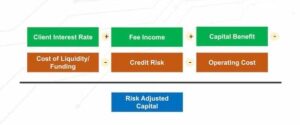 One of the most powerful features for professional bank steering is the risk-adjusted return on capital (RAROC).
Calculating RAROC requires several critical inputs:
Probability of Default – Derived from your rating and scoring models.
Loss Given Default – Based on collateral details stored in Q-Lana and on historical recovery data.
Exposure at Default – Determined from the institution’s own experience and portfolio composition.
From these factors, the Expected Loss can be estimated. Next, an Unexpected Loss is derived by applying confidence levels and correlation assumptions—concepts that Q-Lana’s advisory service can help refine. Together, Expected and Unexpected Losses inform how much capital the bank needs to reserve to cover potential credit losses.
RAROC then becomes the ratio of (revenues minus costs and expected losses) to the risk capital. By integrating these calculations directly into the Q-Lana platform, institutions can readily see how each loan or portfolio segment contributes to the overall risk-return balance, and can make timely adjustments to meet strategic targets.
Please note that we have a full training article the subject of Risk Adjusted Return on Capital.
Step 5: Knowledge Management
 Finally, Q-Lana elevates the concept of data collection with a structured knowledge management approach. Rather than merely storing files, Q-Lana creates a constantly growing repository of both quantitative and qualitative information:
Historical Preservation – Even as fresh data is added, previous assessments remain accessible for trend analysis.
Reporting and Grading – Each data point can be assigned a grade (1 to 5) to capture nuanced insight into risk trends or operational metrics. Aggregating these grades provides early warning signals of portfolio deterioration.
Covenant Tracking – Q-Lana’s workflow tools remind staff of covenant deadlines and automatically highlight compliance status with a traffic-light system (green, yellow, red).
Questionnaires and Checklists – These configurable modules capture additional data points for risk management or ad-hoc reviews, ensuring the platform can adapt quickly to new regulatory or strategic priorities.
By structuring knowledge in this way, Q-Lana ensures that data is not just “archived” but is continuously used to sharpen lending processes, refine risk assessments, and improve customer experiences.
Real-World Impact: Risk Appetite and Early Warnings
At the heart of Q-Lana’s approach is helping institutions define and operate within a clearly articulated risk appetite. This starts at the governance level—setting strategic targets for acceptable risk and return profiles. Q-Lana’s sector assessments, borrower ratings, and transaction-level analytics then transform these policies into actionable guardrails for day-to-day lending operations.
Ongoing monitoring is another pillar of Q-Lana’s risk management framework. An early warning system evaluates client interactions, covenant compliance, and data analytics. If warning signs arise, exposures can be flagged for heightened scrutiny or moved to a watchlist for specialized monitoring—a proactive method that often catches problems before they escalate.
Enhancing the Customer Journey
All of the data gathered and analyzed via Q-Lana can be leveraged to enrich the client experience. By understanding each client’s unique profile, financial institutions can develop tailored customer journeys that align with their risk appetite and the client’s needs. Q-Lana’s flexibility allows you to incorporate feedback loops, customize processes, and personalize services, ultimately strengthening customer relationships and loyalty.
Conclusion: A Holistic Steering Instrument
Q-Lana stands out as more than just a loan management tool. It becomes the central repository of institutional knowledge, a real-time analytics hub, and a strategic partner in reengineering processes around risk management and customer centricity. Backed by three decades of expertise and an open-minded approach to emerging technologies, Q-Lana not only digitizes lending processes but also provides the insights and advisory services that elevate bank steering to the next level.
Whether you aim to refine risk models, optimize returns, or craft a truly customer-centric operation, Q-Lana’s combination of advanced technology and experienced consultants helps you connect the dots and drive your financial institution forward. In short, Q-Lana positions itself at the very core of bank operations—transforming good intentions into informed actions and fostering lasting institutional success.
For more information on how Q-Lana can enhance your institution’s steering capabilities, or to dive deeper into any of the concepts introduced here, we invite you to follow our video series and explore the additional training programs and advisory services Q-Lana offers.