
Guaranteed Crop Price Loans Need Three Checks First
A guaranteed crop price tells you what farmers should be paid. It doesn’t tell you whether anyone will buy the crop. Three simple questions will show whether your loan is safe.
Lending against a guaranteed crop price is safe only when a buyer has actually agreed to pay that price, when your borrower has enough cash to keep going if that buyer is slow to collect, and when the price hasn’t moved too far from what cocoa fetches on the world market or across the border. If you check those three things before the loan goes out, you will know most of what you need to know about it.
None of this takes long, usually an afternoon with the credit file and a phone call to the borrower. However, lenders in Ivory Coast and Ghana who skipped it this season are now finding out how expensive that shortcut was.
The three checks now run as one sentence instead of a list of short ones, so the opening reads like someone explaining it rather than ticking boxes.
A guaranteed crop price can still leave a loan unpaid
Many African governments set a minimum price for cocoa, coffee, cashew, maize and other crops at the start of each season. This is known as the farm gate price, and it is what farmers are promised when they sell their crop. Lenders tend to find it reassuring, because it seems to tell them in advance what the farmer will earn and, by extension, what the cooperative buying from that farmer will earn, too.
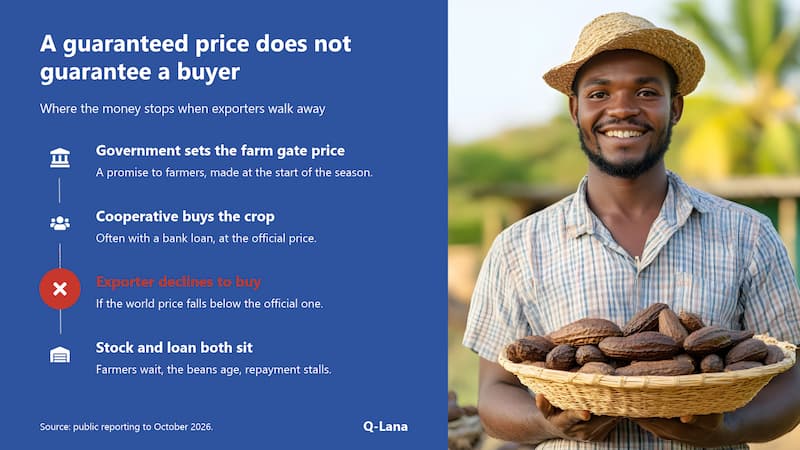
The catch is that the government guarantees the price but not the sale, so the buyer is still free to walk away. If the world price drops below the official one, exporters can simply stop buying, and the crop ends up sitting in a warehouse with the loan that paid for it stuck there alongside it.
What happened to the guaranteed crop price in Ivory Coast?
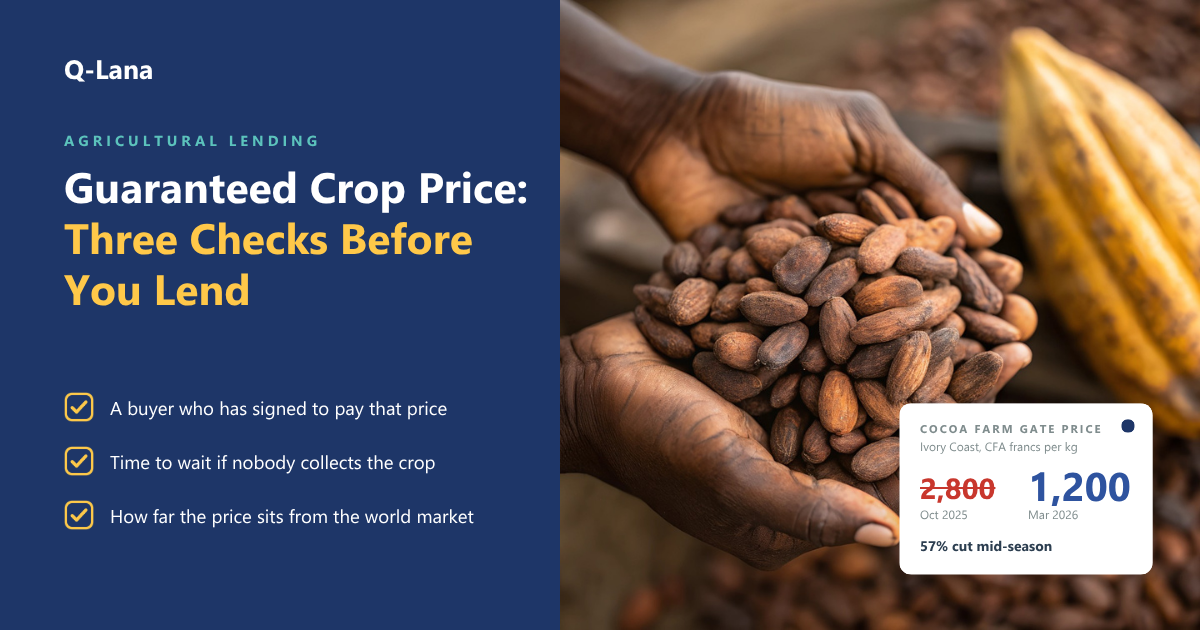
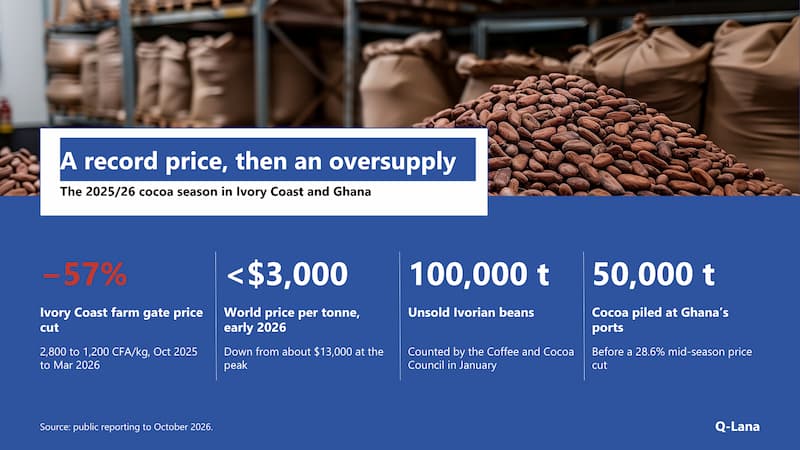
In October 2025, just before the presidential election, Ivory Coast set a record farm gate price of 2,800 CFA francs per kilo of cocoa, even though world prices had already started to fall that summer. By early 2026 they were below 3,000 dollars a tonne, down from about 13,000 at the peak.
At 2,800 francs, exporters could no longer sell the cocoa at a profit, so they stopped buying it. In the western town of Duékoué, one cooperative had bags of unsold beans stacked almost to the warehouse ceiling and told Reuters it owed its farmers a lot of money, while some farmers were handed slips of paper showing what their cocoa was worth instead of being paid in cash.
In the eastern region of Indénié-Djuablin, cooperatives were sitting on more than 11,000 tonnes by March. Their leader explained that they had bought the cocoa expecting to sell it at 2,800 francs, but nobody was taking it, which left them unable to pay their farmers or buy the next crop.
The government eventually stepped in. In January, the Coffee and Cocoa Council counted 100,000 tonnes of unsold beans and started buying them at the full 2,800 francs, and it later had to speed up those purchases because the stored beans were losing quality. Farmer unions said the real volume was higher, and in July they called for an independent audit, saying that stock which had already been counted was still sitting in cooperative warehouses.
In March, the government cut the price by 57 percent to 1,200 francs for the mid-crop, and on 1 September it kept it at 1,200 francs, about 2.12 dollars a kilo, for the 2026/27 main crop.
Ghana went through much the same thing
In February, after about 50,000 tonnes of cocoa had piled up at its ports, it cut its producer price by 28.6 percent in the middle of the season. Ghana’s licensed cocoa buyers say they owe local banks 7 to 8 billion cedis, roughly 650 to 750 million dollars, on loans they took out to pre-finance their purchases, and the Ghana Association of Banks has confirmed that its members are exposed. In March, a group of banks owed 257 million cedis by the state-owned Produce Buying Company went to court to get an order to sell its assets.
Ghana opened the new season at 42,400 cedis a tonne, well above the price in Ivory Coast, and its cocoa board now says beans are being smuggled from Ivory Coast into Ghana across four border regions, which is the reverse of what used to happen.
Both countries set their guaranteed crop price when cocoa was expensive, and the world price then kept falling. What caught many lenders out was how long the stock sat unsold, and how little the official price did for their borrowers while they waited for a buyer. Each of these problems would have shown up in the three checks below before the loan went out.
Check 1: Who has agreed to buy at the guaranteed crop price?
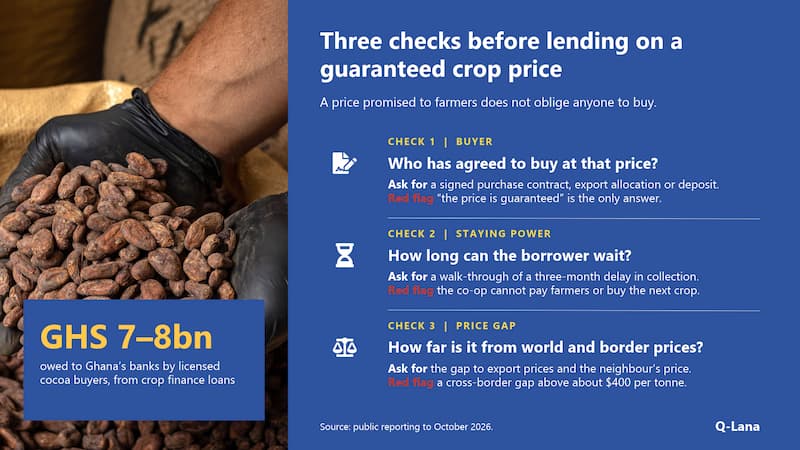
An announced price is a promise from the government to the farmer, and only a signed contract ties a buyer to your borrower. In Ivory Coast, the price was official, yet exporters still refused to pay it once the world price dropped below it.
So before you lend, ask who the buyer is and what they have actually signed. A purchase contract, a confirmed export allocation or a deposit already paid tells you far more than the official price list does. If all you hear is “the price is guaranteed”, then the loan is resting on the government alone.
It is also worth comparing the official price with what exporters can get on the world market, because when the farm gate price is higher than what they can sell for, the buyer has every reason to hold back and wait.
Check 2: How long can your borrower wait if nobody pays the guaranteed crop price?
Most crop loans are planned around a smooth season, where the cooperative buys from farmers, sells to an exporter a few weeks later and then repays the bank. This year those few weeks stretched into several months, so it is worth asking the borrower to talk you through what would happen if the buyer took three months to collect:
- Who would pay the farmers in the meantime, and where would that money come from?
- What does storage cost, and who would carry that cost?
- How long could the beans be stored before they start to lose quality? In Ivory Coast this year, stored cocoa had to contend with damp, mould and theft.
- Could the loan be extended without the borrower falling into default on paper?
If it turns out the cooperative would be unable to pay its farmers or buy the next crop, the loan needs a longer grace period, a smaller amount, or some way of keeping track of the stock while it waits, such as warehouse receipts or regular stock counts.
It also matters who gets paid first when the money finally arrives. In Ghana, the cocoa board released funds to buyers in March to clear what farmers were owed, but farmers and purchasing clerks said they hadn’t received it, and people began asking whether the money had gone to repay bank loans instead. A lender who understands how cash moves from the buyer to the borrower and then on to the farmer is far more likely to spot that kind of problem early.
Check 3: How far is the guaranteed crop price from the world market and the neighbours?
A farm gate price far above the world price stops exporters from buying, while a price far below the neighbouring country’s pulls the crop across the border, and West Africa saw both happen within twelve months.
Industry officials say smuggling tends to jump once the price gap between two countries passes about 400 dollars a tonne. In September, analysts put the gap between Ghana’s proposed price and Ivory Coast’s at close to 1,700 dollars.
For a lender, smuggling tends to show up in three ways:
- A cooperative near the border collects less cocoa than it planned to, so its income falls while its loan stays the same.
- A buyer on the other side of the border takes in beans it cannot trace back to a farm.
- The buyer’s export sales come under threat, because the EU Deforestation Regulation, expected to apply to cocoa exports from 30 December 2026, depends on knowing where each bag came from, and beans that crossed a border at night have no such record.
Thus, it pays to look at where your borrowers are, because a cooperative within reach of a border needs a more cautious volume forecast than one in the middle of the country.
The same checks work for any guaranteed crop price
Coffee, cashew, maize and tea often come with an official price as well, and the same thinking applies to all of them. A guaranteed crop price tells you what the farmer has been promised, but only the buyer can tell you whether the crop will actually sell, and lenders who keep those two things separate will have far fewer surprises next season.
The weather makes these checks more urgent this year. Ghana’s cocoa board expects this season’s crop to be about 13 percent smaller than last year’s, and Ivory Coast’s main crop is running eight to ten weeks late. If you also lend to farmers in East Africa, our El Niño 2026 Bank Advisory Guide explains how to support agricultural SME clients through the short rains.
How Q-Lana helps with guaranteed crop price lending
Q-Lana works with banks, microfinance institutions and funds that lend to agriculture and small businesses.
We can help in three ways:
1. Review your agricultural book.
We go through your portfolio with you and apply checks like these to each borrower: who the buyer is, how long stock can wait, and how exposed the borrower is to a border or a price change.
2. Keep track of it on one platform.
The Q-Lana loan and asset management platform records the buyer, the collateral and the covenants behind each loan, and follows them through the season. A stuck season then shows up as missed checks and late stock counts, well before it shows up as arrears.
3. Train your credit team.
Our SME Excellence Program and online classes teach credit officers how to assess agricultural borrowers, including cash cycles and seasonal risk.
Talk to us
If you finance cocoa, coffee or any other crop sold at a guaranteed crop price and would like a second opinion on your book:
Book a call with a practitioner, now about crop finance deals
Book a call with a practitioner Bring a cooperative loan or crop finance deal you’re unsure about. You’ll talk to someone who has lent to agriculture through difficult seasons, not a sales team.
Get the free guide
Prepare your farming clients for El Niño Lend to agriculture in East Africa? Our free El Niño 2026 Bank Advisory Guide shows how to support agricultural SME clients through the short rains, before missed repayments start.
Follow Q-Lana
One short email a week on credit risk, lending and impact finance, free. Or browse more guides in the Q-Lana Knowledge Center.
Get Q-Lana Weekly
One short email a week on credit risk, lending and impact finance, free. Or browse more guides in the Q-Lana Knowledge Center.
This article is based on public reporting up to October 2026, some of which we translated from French. Figures for unsold stocks, arrears and smuggling vary between sources and are given as reported.