
Credit Risk Measurement Should Come Before Instinct
This is Article 1 of 5 in the Q-Lana Risk Management series. Credit risk measurement rests on probability of default, loss given default and exposure at default. It explains each one, where lenders misjudge it and the data needed to calibrate them.

Credit risk measurement should come first, because every credit decision already depends on three numbers. Each approval assumes a probability of default, a recovery and an exposure. The real question is whether anyone chose those numbers or everyone simply assumed them. This article explains the three variables and where institutions most often get each one wrong. It also covers the data needed to measure them reliably.
Three questions behind every approved facility
A credit committee approves a facility. Ask three questions about it. How likely is the borrower to fail within a year? If it fails, how much of the exposure will the bank lose? How much will actually be outstanding at that point?
Every approved facility already contains an answer to all three. The decision could not have been made without them. The only difference is whether the numbers came from evidence or from the mood in the room.
An institution that cannot state a borrower's probability of default is expressing an opinion about credit risk. An opinion cannot be priced, aggregated, back-tested or defended before an auditor.
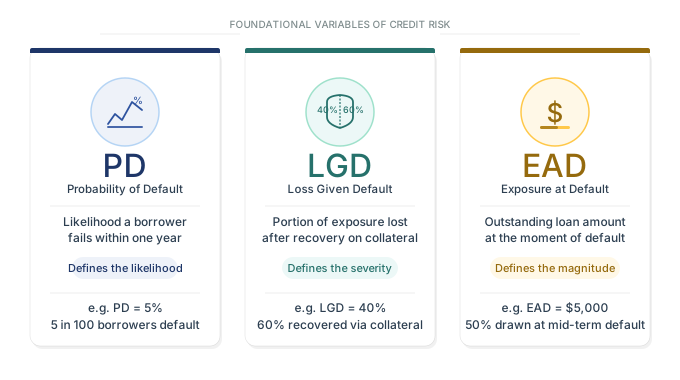
Credit Risk Measurement in Three Variables
Credit risk breaks down into three measurable components, and each answers a different question.
Probability of Default defines the likelihood. Loss Given Default defines the severity. Exposure at Default defines the magnitude.
Multiplied together, they give expected loss, the subject of the next article. Taken one at a time, they form the working vocabulary of every credit decision.
Together, they describe one loan: how likely, how bad, and how much.
a. Probability of Default: how likely
Probability of Default (PD) is the likelihood that a borrower fails to meet its obligations within a defined horizon, conventionally one year. It is a percentage, and it is the single most consequential number in the file.
What a 5% PD means
A 5% probability means a 5 % chance this borrower defaults in the next twelve months. Across a portfolio of twenty comparable borrowers, the expectation is that one of them does. That framing is worth holding on to, because it is how the number behaves in practice: not as a prediction about one client, but as a rate that only means anything across a population.
Determining it involves predictive models built on historical data, financial performance indicators and borrower-specific factors. Credit scoring and rating systems classify borrowers into risk categories: strong financials to a low probability, weaker profiles to a higher one. The models produce an ordering, and the ordering is then calibrated to the default rates actually observed over time.
That calibration step is where institutions most often stop short. A rating scale that ranks borrowers correctly but has never been mapped to observed default frequencies gives you relative risk without absolute risk. You know which borrower is worse. You do not know what either of them costs.
Through-the-cycle and point-in-time PD
One further distinction is worth naming, because it causes more confusion in practice than it should. A through-the-cycle probability estimates a borrower's default rate averaged across economic conditions. A point-in-time probability estimates it under conditions as they stand today. Both are legitimate. They answer different questions, and they will differ, sometimes considerably, at the top and bottom of a cycle. A probability quoted without its convention is ambiguous, and ambiguity in this number propagates into every calculation downstream of it.
b. Loss given default: how bad

Loss given default is the share of exposure lost after recoveries. If the outstanding balance is $10,000 and $6,000 is recovered from collateral, loss given default is 40%.
It is the inverse of the recovery rate, which sounds like arithmetic and is actually the point. Recovery is a process, however, is a process, and three factors drive it:
i. Collateral type and liquidity
Collateral, by type and by liquidity rather than by valuation. Cash and government securities convert quickly and reliably, so they reduce loss given default materially. Illiquid or complex collateral may not reduce it at all. Real estate held in a foreign jurisdiction carries valuation uncertainty and legal friction, and a security interest that cannot be enforced promptly is not doing the job the credit file assumed it would.
ii. Market conditions at enforcement
Banks usually enforce collateral in a downturn, when conditions are worst. Property prices fall, inventory liquidates below book, and equipment finds no buyer. Recovery assumptions set in a benign year are tested in a bad one, and correlation between default and collateral value is not a detail.
iii. Recovery time
Lengthy enforcement or legal proceedings consume value through holding costs, depreciation and expenses. A recovery that arrives in four years is worth less than the same nominal amount in one, and the asset itself rarely improves while the process runs.
Put those three together, and the practical conclusion follows. A loss given default assumption is not a number you look up. It is a claim about your own enforcement capability, in a specific jurisdiction, under conditions you do not control.
c. Exposure at Default: how much

Exposure at Default (EAD) is the amount outstanding when the borrower defaults, and it is the variable most often set wrong, because the obvious answer is usually the wrong one.
Term loans
For a term loan, exposure declines with amortization. Halfway through the tenor, on a normal repayment pattern, exposure is roughly half the original amount. The obvious answer works.
Revolving facilities
For a revolving facility, the obvious answer fails. A borrower approaching distress draws down. By the time default arrives, utilization is at or near the limit, which is why the working assumption for a line or an overdraft is the full facility rather than the current balance. An institution sizing exposure on today's drawn amount is systematically understating what it will actually be owed.
Behavior and contract terms
Good EAD estimates rest on three behaviors:
- how borrowers use revolving limits
- how drawdown trends move
- how often and when term loans prepay, and where in a facility's life defaults tend to cluster.
Contractual terms move this number. Prepayment clauses, financial covenants and drawdown conditions each cap exposure or accelerate its reduction, which means the structuring decision made at origination is also a risk-measurement decision. That connection is usually invisible in the credit file, and it should not be.
PD, LGD and EAD are not three models. They are one sentence about a loan: how likely, how bad, how much. An institution that cannot say that sentence out loud is not measuring credit risk. It is describing it.
What Credit Risk Measurement Changes for The Institution
Making the three variables explicit changes four things straight away.
- Pricing becomes defensible, because the risk component of the margin is derived rather than negotiated.
- Portfolios become comparable, because two facilities in different sectors can be held against the same scale.
- Decisions become reproducible, because the inputs as they stood are recorded alongside the conclusion. And the institution becomes able to learn, because an estimate that was written down can be compared with what actually happened.
The last of these builds over time. A rating scale calibrated against five years of your own observed defaults is worth more than a bought model, because it is trained on your borrowers, your sectors and your enforcement environment. The institution that writes the numbers down now will have a usable dataset in three years. The one that carries them in judgment has three years of anecdotes.
Building This in Your Team
The Q-Lana Financial Skills Campus runs a credit risk measurement course for credit teams and risk functions. It covers rating and scoring design and calibration to observed default rates. It also shows how PD, LGD and EAD connect through to pricing and capital. The course is taught on your own portfolio.
Next in This Series
The next article takes the three variables and multiplies them, and argues that the result is not a risk at all. It is a cost, and it belongs in the pricing grid rather than the risk report.
Score One of Your Borrowers
The fastest test of whether these variables are real in your institution is to score a borrower against them and see how quickly you can. The rating calculator takes a borrower through a combined qualitative and quantitative scale and returns a grade you can argue with.
Score a borrower in the scoring and rating calculators on our website
The full treatment of all three variables, with worked examples running through to expected loss, capital and RAROC, is set out in the Q-Lana white paper Credit Risk and Risk Appetite.
Download the white paper
All the Articles in This Series:
- Credit Risk Measurement Should Come Before Instinct (this article)
- Expected Loss Is a Cost Every Loan Must Cover
- Loan Loss Provisions Enough to Protect the Bank
- Is Loan-Level Capital a Constraint or a Signal?
- RAROC Separates Good Lending From Profitable Lending
Follow Q-Lana
One short email a week on credit risk, lending and impact finance, free. Or browse more guides in the Q-Lana Knowledge Center.
Get Q-Lana Weekly
One short email a week on credit risk, lending and impact finance, free. Or browse more guides in the Q-Lana Knowledge Center.