
RAROC Separates Good Lending From Profitable Lending
This is Article 5 of 5 in the Q-Lana Risk Management series. RAROC shows whether a loan's return justifies the capital it consumes. One loan starts at minus 20.14 per cent, and three structuring levers lift it to 21.76 per cent.

RAROC separates the two only when the bank calculates it before approval. In most institutions, profitability comes up about eighteen months after a loan is approved. A team then spends two weeks building an answer nobody can act on. Pricing, structure and collateral were all settled at origination. Risk-adjusted return on capital (RAROC) moves that question to the credit committee. It asks whether the return justifies the capital the facility will consume. This article builds the loan price, calculates RAROC on the series loan and tests three structuring levers.
How a Loan Price is Built
Profitability starts with pricing. The rate charged to a client has four components. Banks give away margin when they blur them together.
- Cost of funding. What it costs to source the money, from depositors, investors or the interbank market. Treasury owns it through transfer pricing.
- Cost of credit risk. The expected loss, from the three variables in the first article. This is not a buffer or a cushion. It is a cost of goods sold, and it belongs in the rate at full value.
- Operating expenses. Salaries and administrative overhead. Note the important property: these are a currency amount rather than a percentage, and they barely move with loan size. That single fact drives one of the three levers below.
- Profit margin or subsidy. Management's target return, or a deliberate concession on a specific transaction.
Unexpected loss also reaches pricing indirectly. An institution with a riskier profile pays more for its own funding, and its shareholders demand more for their capital. Risk shows up in the rate twice: once for the borrower's, once for the lender's.
Expected loss belongs in the rate
Expected loss comes from the three variables in the first article. It is part of the cost of lending, much like cost of goods sold in a manufacturer. It should enter the rate at full value. A bank that discounts it is funding a known loss from its margin.
Operating costs hit small loans hardest
Operating expenses are a currency amount, not a percentage of the loan. They barely change with loan size. A 10,000 facility and a 20,000 facility need much the same credit memo, review and monitoring. This one fact drives the first lever discussed below.
Risk enters the price twice
Unexpected loss also reaches pricing indirectly. A lender with a riskier book pays more for its own funding. Its shareholders also demand a higher return on their capital. The price therefore reflects the borrower's risk and the lender's risk.
How is RAROC Calculated?
RAROC divides risk-adjusted return by the capital the loan consumes. Two items enter the calculation alongside the four price components.
RAROC = (Revenue + Fees + Capital benefit − Funding − Expected loss − Operating costs) ÷ Economic capital
Fee income is revenue the interest rate does not capture. Capital benefit recognizes that equity funds part of the loan. That equity carries no interest, so the effective funding cost falls.
RAROC on the series loan
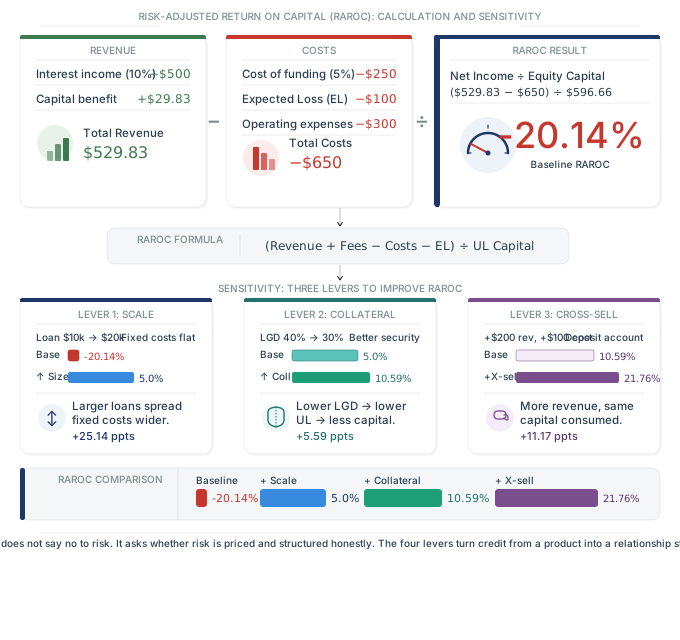
The loan used in this series as an example is for an amount. PD is 5% , LGD 40 % and EAD 50%. he average outstanding balance over the term is 5,000.The previous article put its equity capital at 596.66.
At a 10% interest rate, first-year interest revenue is 1,000, but on average over the four years the revenues are 500. Capital benefit adds 29.83. Total revenue: 529.83.
Funding at 5% costs 250. Expected loss is 100. Operating expenses are 300. Total cost: 650.
Net income of - 192 against equity capital of 596.66 gives RAROC of -20.14%.
Testing against a 12 per cent hurdle
For the sake of the sensitivity analysis following here, we assume that the bank has a hurdle return of 12%. At this stage, that hurdle rate is not met, and the economic profit resulting from this transaction is -192.
Three Levers, and What Each is Worth

This is the part that changes what a relationship manager has to do now. The same loan, three interventions stacked one on the next, and the effect of each is specific. The starting point matters. As first structured, this loan returns minus 20.14 per cent, well below any sensible hurdle. It is not a marginal deal. It is a loss. What follows is how three ordinary structuring moves, applied in sequence, turn it into a positive return.
i. Scale
- 20.14% to +5%. Double the loan from 10,000 to 20,000 and the return crosses from loss into profit, a swing of more than twenty-five points, because operating expenses do not scale with loan size. The same 300 of overhead is now spread across twice the revenue base. This is the most powerful lever on the list and the most dangerous, because it improves the ratio by increasing the absolute exposure. A better RAROC on a larger loan is not automatically a better decision..
ii. Collateral
+5% to +10.59%. On that larger loan, improve the security so that loss given default falls from 40% to 30%, and the return gains more than five points. Lower loss given default means lower expected loss and lower unexpected loss, so the facility consumes less capital and costs less to carry. The commercially interesting move here is to hand part of that gain back: better collateral can fund a lower rate for the client while leaving the institution better off. That is the rare negotiation where both sides genuinely win, and it is available on almost every deal.
iii. Cross-sell
+10.59% to +21.76%. Add a deposit or salary account generating 200 of revenue at a 50% cost-income ratio, and the return rises more than eleven points. The capital consumed does not change at all. This is why relationship depth is a capital efficiency question and not only a revenue one.
The point is in the sequence. Each lever is measured on top of the one before it, not against the original loss. That is how a transaction which started at -20% reaches a healthy return without a single change to the borrower’s credit quality, three structuring decisions, not a better borrower.
Interest rate and maturity
Two further variables move the number without appearing in the three headline levers. Interest rate moves revenue directly, which is why a strong borrower can be repriced downward without necessarily breaking the hurdle. Maturity moves exposure at default and therefore both loss measures, which is why extending a tenor to make an instalment work is a capital decision disguised as a courtesy.
What do the levers show?
RAROC does not say no to risk. It tests whether risk is priced and structured properly. The levers turn credit from a product into a relationship strategy.
Building this in your team
The Q-Lana Financial Skills Campus runs a credit risk measurement course for credit teams and risk functions. It covers rating and scoring design and calibration to observed default rates. It also shows how PD, LGD and EAD connect through to pricing and capital. The course is taught on your own portfolio.
Using RAROC in the wrong way
Institutions misuse RAROC in two ways, and both waste it.
i. RAROC as a gate
Used as a gate, RAROC becomes a reason to decline. A facility below hurdle is rejected, and the RM stops bringing marginal deals. Over time the bank narrows to whatever clears the threshold easily.
ii. RAROC as a diagnostic
Used as a diagnostic, it becomes a way to restructure. A facility below hurdle prompts a different question: which lever moves it, and at what cost to the client relationship. Collateral, tenor, fees, cross-sell, size. Very few below-hurdle facilities are bad loans. They are loans structured without anyone knowing what they consumed.
The difference between different financial institutions is that they can run the same formula and get very different results. What separates them is whether the figure reaches the assessment and approval stage in time to change the structure. The EBA guidelines on loan origination also expect differentiated pricing for different loans and borrowers.
How RAROC Completes the Series
The five articles in this series form one chain.
1. PD, LGD and EAD give expected loss.
2. Expected loss is a cost that belongs in the price. It says nothing about variability.
3. Variability is unexpected loss, sized by a confidence level the bank chooses.
4. That capital is consumed loan by loan, not in aggregate.
5. RAROC sets the return against the capital, so each earlier measurement supports a decision.
What happens when a link is missing?
Take any link out and the chain stops carrying weight. Measure the variables and never price them, and you have a risk department. Price them and never allocate capital, and you have a margin you cannot defend. Allocate capital and never compute the return, and you have a compliance exercise.
Measurement without steering is reporting. Steering is the subject of the next series, which takes all of this and asks the question a board actually has to answer: how much risk, of what kind, are we willing to carry, and who decides when we have carried too much.
Next in This Series
The three levers are far more convincing when you move them on a facility of your own. The calculator takes the same inputs used above and shows what each lever is worth on your numbers rather than on the example.
Test The Levers on Your Own Facility
Q-Lana · Risk Management
One loan, three levers
As first structured, this loan loses money. Flip the levers in order and watch the risk-adjusted return climb past the hurdle, without changing the borrower's credit quality.
Loan $10,000 · PD 5% · LGD 40% · Maturity 4 years · Hurdle 12%
This is the short version
The full RAROC calculator lets you set every input yourself, loan size, PD, LGD, maturity, fees and capital benefit, and watch the return and the capital move line by line. It sits alongside the Basel capital tools in the Q-Lana Financial Skills Campus.
See it on the Q-Lana site Take the courseThe full derivation, the pricing components and the sensitivity analysis are set out in the Q-Lana white paper Credit Risk and Risk Appetite.
All the Articles in This Series:
- Credit Risk Measurement Should Come Before Instinct
- Expected Loss Is a Cost Every Loan Must Cover
- Loan Loss Provisions Enough to Protect the Bank
- Is Loan-Level Capital a Constraint or a Signal?
- RAROC Separates Good Lending From Profitable Lending (this article)
Follow Q-Lana
One short email a week on credit risk, lending and impact finance, free. Or browse more guides in the Q-Lana Knowledge Center.
Get Q-Lana Weekly
One short email a week on credit risk, lending and impact finance, free. Or browse more guides in the Q-Lana Knowledge Center.