Most SME Lending Problems Stem From Capability Gaps, Not Credit Problems
SME lending challenges often stem from limited institutional capacity to assess, structure, and manage credit effectively. Closing these gaps is key to sustainable SME portfolio growth and resilience.
Across emerging markets, banks and microfinance institutions often say the same thing: "We want to grow SME lending, but the risk is too high." That concern is understandable but often misdiagnosed.
The core challenge is rarely that SMEs are inherently "too risky." More often, institutions lack the repeatable capability to understand, structure, and manage SME risk consistently across teams, branches, and time.
This is why we developed the SME Finance Excellence Program, and why we are now actively looking for partners: banking associations, MFI networks, financial groups, and development platforms, to incorporate and localize the program across countries and regions. SME finance is local by nature: strengthening it requires local institutions, trainers, and market understanding.
The Illusion of High Risk
Many institutions still assess SME credit risk with tools originally designed for corporates. Financial statements are reviewed backward-looking, ratio thresholds are applied rigidly, and collateral often becomes the dominant comfort factor. Approval processes are frequently detached from how SMEs actually generate cash.

Meanwhile, many SMEs operate with informal or semi-formal records. They combine household and business cash flows. They demonstrate strong sector logic and resilience but lack balance-sheet polish. What banks often see as opacity is, in reality, a difference in structure.
The predictable outcome is caution. And caution is not wrong. But without structured capability, caution becomes over collateralization, missed opportunities, and inconsistent decisions. The issue is not prudence. The issue is the ability to create decision-quality with imperfect information.
Want to benchmark your SME credit capability?
Existing Approaches Fall Short: That's Good News
Many institutions have invested in SME training: staff attend courses, work on global case studies, return well informed but often not empowered. This is because the training rarely changes how credit decisions are made on Monday morning or connects analysis, structuring, monitoring, and governance into one coherent discipline.
The next generation of SME finance training must move from knowledge transfer to capability formation, from theory to applied discipline, from generic cases to real local SMEs.
SME Finance Is an Engineered Discipline
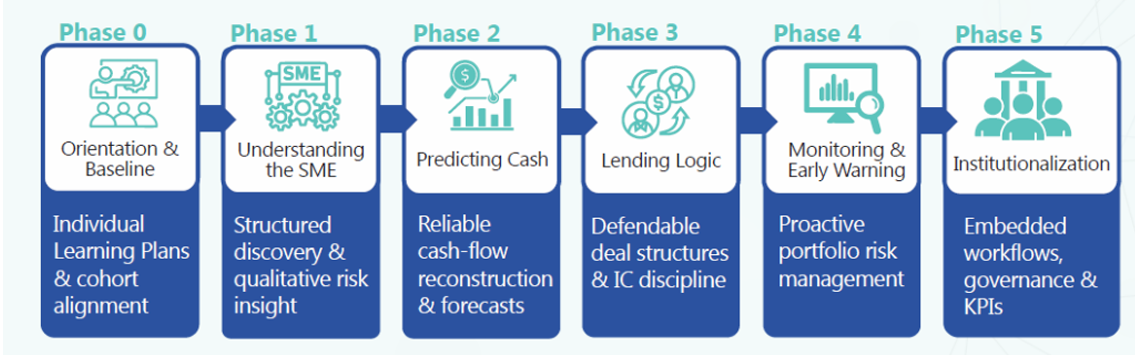
Effective SME Lending is engineered, not improvised. It requires mastering a connected chain of capabilities: understanding how SMEs operate, reconstructing reliable cash flows, structuring facilities aligned with risk appetite, and monitoring proactively before warning signs become arrears. Break any link, and portfolio quality suffers, often quietly at first.
This is the insight behind the SME Finance Excellence Program: a six-month institution-building journey, not a classroom event. Participants work on real SME cases in their own market, producing the same artifacts required in daily credit work: cash-flow forecasts, risk maps, term sheets, monitoring dashboards, early-warning triggers, and committee-ready decision notes.
Why Localization Matters
SME finance cannot be imported as a template: cash cycles in agriculture differ from trade, informality varies by country, regulatory constraints differ across regions, sector exposure patterns are local, even behavioral norms in credit committees are local. Q-Lana provides the methodology, supervision, quality standards, and learning architecture; the market provides the context: creating global discipline with local relevance.
A Stronger Future for SME Finance
The demand for SME finance is not the problem. The ambition is not the problem. The opportunity lies in professionalizing SME lending so growth and risk management move together. Institutions that invest in structured capability typically see stronger portfolio quality, clearer risk appetite alignment, and more confident expansion into underserved segments: building trust with SMEs by applying standards intelligently, not relaxing them.
Introducing the SME Finance Excellence Program
Christian Ruehmer (Co-Founder & CEO) notes that SME finance is not held back by a lack of ambition: it is held back by a lack of repeatable capability: the ability to make high-quality credit decisions, monitor proactively, and act early, consistently, across teams and branches.
Key Components of the Program
The program is built around one non-negotiable principle: if learning does not change how credit decisions are made, it has failed. Participants build practical institutional assets using: structured discovery scripts, cash-flow reconstruction models (it's cash, not profit, that pays the debt service), risk hypothesis frameworks, term-sheet logic tied to risk appetite, and monitoring dashboards with early-warning indicators. By the end, institutions have an SME Lending Playbook embedded into their operations.
Moving Forward
If you are a financial institution seeking to strengthen SME lending discipline, we welcome a conversation about running an in-house cohort. If you are a banking association, MFI network, or industry platform looking to strengthen the SME finance ecosystem in your country or region, we are actively seeking partners to localize and embed the program.
SME finance is not failing because SMEs are too risky. It is underperforming because institutions have not yet fully engineered the capability to manage that risk at scale. Fix the capability, and the portfolio follows.
Partner With Us
If you are a banking association, development partner, or industry body, we can structure a partnership around member value proposition and certification pathway, regional cohorts and sponsorship models, and institutional diagnostics with baseline capability assessment.
Continue the Conversation
Talk to the team. Senior-to-senior. No sales call.
Subscribe to Q-Lana Weekly. One newsletter, five lenses, free, no paywall.
Read the related white paper. Frameworks built to be deployed.