Provisions Are Not Enough: Understanding Unexpected Loss
This is the second article of the 5-part Credit Risk Management in SME and Corporate Lending series. We delve into the limitations of relying solely on provisions, and how to anticipate and plan for unexpected losses. Risk management should be proactive, not reactive.
Many institutions walk into a credit crisis believing they were prepared: provisions booked correctly, coverage ratios looking healthy. Then conditions shifted, and the provisions ran out.
This is not a story about negligence, but a fundamental misunderstanding of what provisions are designed to do and what they are not. The answer lies in the distinction between Expected Loss and Unexpected Loss.
Want to strengthen your approach to credit risk management?
Our whitepaper explains the key concepts, methods, and frameworks financial institutions can use to measure, manage, and price credit risk.
A Point That Often Gets Missed: Risk Lives in the Performing Portfolio
Many institutions focus risk attention on the non-performing portfolio: defaulted loans, arrears, the watch list. These matter, but they are lagging indicators; by the time a loan is non-performing, the risk decision that created it was made months or years earlier.
What credit risk measurement should really achieve is a clear understanding of the performing portfolio: loans still paying, but where credit quality may be quietly deteriorating.
Risk is not the defaulted loan; risk is the loan that still performs but is heading in the wrong direction.
Want to go deeper?
The Q-Lana Financial Skills Campus offers courses on Monitoring and Covenant Management, covering how to identify changes in credit quality and manage risks before they become larger problems.
Continue your learning with our Credit Risk and Risk Appetite courses.
Expected Loss: The Price of Doing Business
Expected Loss (EL) represents the average level of credit losses an institution anticipates over a given year, calculated as:
EL = PD × LGD × EAD
It is calculated from the three variables introduced in Article 1.
Think of it like an insurance premium. You know, on average, how many claims will arrive. You price for them. You reserve for them. In a stable environment, this works well. Defaults arrive roughly as expected. Losses are absorbed by reserves. Earnings remain smooth.
EL is a cost, not a risk indicator; it tells you what you should plan to lose, but says nothing about the range of outcomes around that plan.
As Q-Lana's framing puts it:
Expected Loss is the price of admission. Unexpected Loss is the price of survival.
The Dangerous Comfort of 'We Are Covered'
Institutions that focus on provisioning develop a seductive narrative: we've set aside the right amount, so we're prepared. They are prepared only for normal years.
Credit losses don't arrive neatly at their average; defaults cluster, economic cycles turn suddenly, borrowers fail together when a sector contracts. The 2008 financial crisis didn't happen because banks provisioned incorrectly for average losses: it happened because the distribution of losses was far wider than expected, and equity capital was insufficient to absorb the tail.
This is the structural limitation of Expected Loss: it describes the center of the distribution, not the extremes. Two portfolios can have identical EL and behave very differently under stress.
▌ The executive question
If default rates moved from 5% to 7% in your key segment, would your provisions cover the additional loss, or would it fall on capital?
Putting It Into Practice
Unexpected Loss: Where Institutions Actually Break
Unexpected Loss (UL) captures the volatility around the average, measuring how far actual losses can deviate from EL under adverse conditions.
UL is driven by:
- Variability in default rates, the difference between 5% and 8% is not linear in its impact
- Correlation between borrowers, sector or geographic concentration amplifies losses
- Macroeconomic shocks, recessions, rate spikes, commodity collapses
- Tail events, rare but decisive, occurring once in decades but capable of restructuring institutions overnight
Critically, UL is covered by equity capital, not provisions. Capital exists to absorb losses that exceed expectations; when losses stay within EL, the institution operates normally, but when they exceed it, survival depends on how much capital is available.
Visualizing the Risk: A Simple Portfolio Reality
Consider a portfolio with EL well understood at 5% and fully provisioned. Most years, actual losses hover around that number. Then conditions change: instead of 5% defaulting, 7% do. Losses rise sharply, provisions are exhausted, and the gap must be filled by capital.
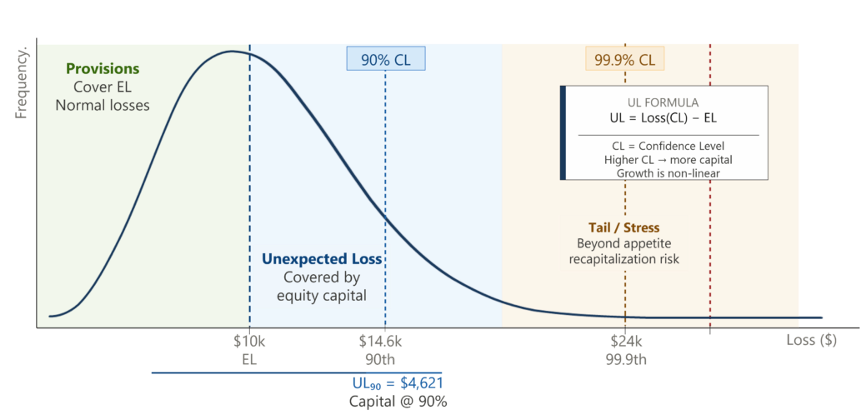
That gap is Unexpected Loss.
If capital is sufficient, the institution absorbs the shock and continues lending. If it is not, lending contracts, regulators intervene, and confidence erodes. This is why crises feel sudden, even when the underlying risk models were technically correct. They were modelling the center of the distribution, not the tail.
The Q-Lana White Paper on Credit Risk includes a worked Monte Carlo simulation of this dynamic across a representative loan portfolio, illustrating how loss distributions behave at different confidence levels. It is worth reading if you want to see the numbers behind the narrative.
Confidence Levels: A Strategic Choice, Not a Technical Calibration
Unexpected Loss is not a fixed number. It depends on how conservative the institution chooses to be, expressed through confidence levels:
- 95% confidence covers losses in 19 out of 20 years
- 99% covers 99 out of 100 years
- 99.9% covers 999 out of 1,000 years.
Each step up requires disproportionately more capital. Based on Monte Carlo modelling across a representative loan portfolio, the jump from 95% to 99% requires meaningful additional equity, and 99% to 99.9% is substantially more expensive still. This non-linearity reflects reality: extreme losses are rare but severe when they occur. Which confidence level to adopt is a strategic question, a statement about the kind of institution you intend to be.
▌ The strategic question
What confidence level does your institution operate at, and was that choice deliberate, or inherited from a regulatory minimum?
From Accounting Logic to Risk Logic
Expected Loss belongs to accounting. Unexpected Loss belongs to risk management and strategy. The most resilient institutions treat provisions and capital as complementary tools, not substitutes:
- Provisions prepare you for normal years
- Capital prepares you for abnormal ones
- The decision about how much capital to hold is inseparable from the decision about how much risk to take.
This is not about holding more capital for its own sake: over-capitalization has its own cost in foregone returns, competitive disadvantage, and inefficient allocation of scarce equity. The goal is calibration: capital that reflects the actual risk profile of the portfolio, held deliberately and allocated precisely
Institutions that manage EL and UL together are not more conservative than their peers. They are more intelligent.
▌ Q-Lana’s approach
Credit risk modelling is the analytical engine that runs through our platform, advisory work, and Financial Skills Campus curriculum. EL and UL are modelled dynamically, not as annual static snapshots. Both metrics feed directly into capital planning, pricing logic, and portfolio dashboards, so management sees not just what it expects to lose, but the range of outcomes it must be prepared to absorb.
▌ Q-Lana Knowledge Resources
White Paper: Credit Risk and Risk Appetite, the full Monte Carlo simulation and UL worked examples are available in Part 1. Download at q-lana.com. Q-Lana
Financial Skills Campus (FSC): Class 1, Credit Risk Measurement and Capital covers Expected Loss, Unexpected Loss, and confidence-level calibration.
FSC Course: Monitoring and Covenant Management, tracking credit quality deterioration in the performing portfolio before it becomes a non-performing problem.
Coming Next
If Unexpected Loss defines how much capital is needed, the next question becomes unavoidable: how should that capital be allocated, loan by loan? Article 3 explains why capital is not a regulatory burden; it is one of the most powerful steering tools a financial institution has.
About this Series
This article is part of Q-Lana's Five-part Credit Risk Management series, exploring how institutions move from intuition to a disciplined, measurable approach to credit risk, capital, and pricing.
The complete series includes:
- Credit Risk Starts with Measurement, Not Instinct
- Capital Is a Signal, Not a Constraint
- RAROC in Practice: How to Separate Profitable Lending from Safe-But-Costly Deals
- Risk Appetite as the Operating System for Strategy, and this article.
Continue the Conversation
Talk to the team. Senior-to-senior. No sales call.
Subscribe to Q-Lana Weekly. One newsletter, five lenses, free, no paywall.
Read the related white paper. Frameworks built to be deployed.