Risk Appetite as the Operating System for Strategy
Finally, the series concludes with a discussion on risk appetite, presenting it as the operating system that aligns strategy, execution, and governance, to ensure responsible growth across the portfolio.
Every financial institution takes risk: that is the business model.
The real choice is whether that risk is taken deliberately or accidentally, coherently or inconsistently, with foresight or in hindsight.
After four articles covering the measurement of credit risk, the capital it demands, and the return it must generate, one question remains: how do we ensure thousands of daily lending decisions add up to the strategy we intend, rather than the risk profile we drift into? The answer is the Risk Appetite Framework: and most institutions are not using it correctly.
Want to strengthen your approach to credit risk management?
Our whitepaper explains the key concepts, methods, and frameworks financial institutions can use to measure, manage, and price credit risk.
Why Risk Appetite Is So Often Misunderstood
They will describe a document, approved annually by the Board, reviewed by the Risk Committee, stored in the governance folder.
They will quote a ratio, NPL below 5%, capital adequacy above 12%. Or they will speak about culture, ‘we are a conservative institution’, ‘we do not chase yield’.
None of these is wrong. But none of them is a Risk Appetite Framework. They are artefacts of one. And artefacts without implementation are governance theatre.
The proof is visible in the pattern that follows: strategy says disciplined growth, incentives reward volume, limits are breached reactively, surprises are explained after the fact. The problem is not lack of intent. It is lack of translation.
Risk appetite fails when it remains abstract, disconnected from capital, pricing, and daily decisions.
The Bridge Between Knowing and Doing
Risk appetite is the bridge between measurement and management.
The analytical chain established in this series, PD, LGD, EAD, Expected Loss, Unexpected Loss, capital allocation, RAROC, provides precision about what risk is and what it costs. But numbers alone do not steer portfolios. People do. Institutions do. And institutions need a framework that translates analytical precision into managerial intent.
A functioning Risk Appetite Framework answers questions that spreadsheets cannot:
- How much volatility are we willing to absorb, and what happens when we approach that limit?
- Which risks are we willing to take, and which are categorically off the table?
- What level of risk-adjusted return do we require before committing capital?
- Where should growth be encouraged, and where should it be slowed or stopped?
Without explicit answers to these questions, institutions do not manage risk appetite. They inherit it, from competitive pressure, from incentive structures, from the accumulated weight of decisions made without a clear framework.
What a Real Risk Appetite Framework Does
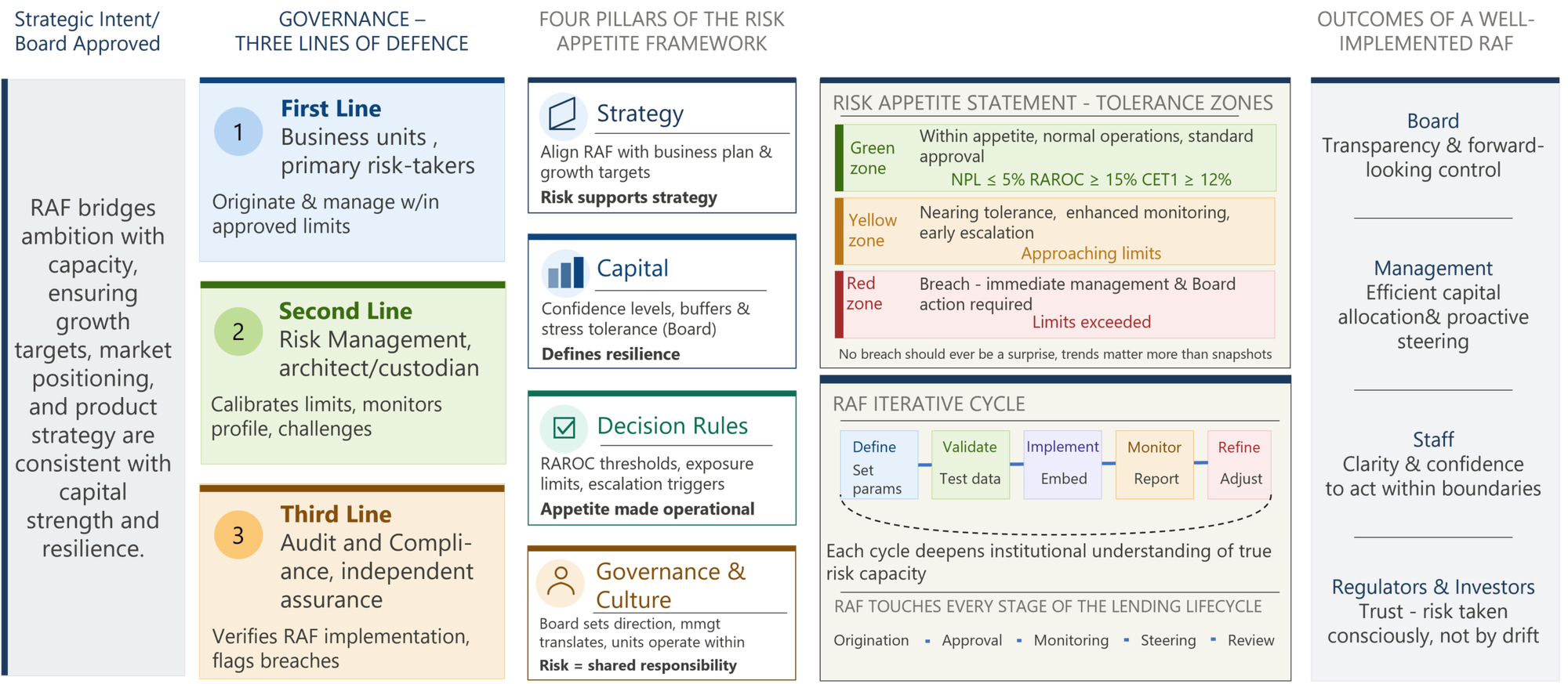
A well-designed RAF aligns four dimensions, and all four must be present for the framework to function.
Strategy
Risk appetite starts with ambition. Growth targets, market positioning, and product focus imply risk whether or not that risk is acknowledged. A bank targeting SME lending in emerging markets has a fundamentally different risk profile than one focused on investment-grade corporate credit. The RAF must make those differences explicit and ensure that ambition is consistent with capital strength and resilience.
Capital
Risk appetite is inseparable from capital planning. The choice of confidence levels, capital buffers, and stress tolerance defines how much uncertainty the institution can survive without destabilizing outcomes. This is not a finance function decision or a risk function decision. It is a Board decision, because it defines the institution’s fundamental resilience.
Decision Rules
Appetite becomes real only when it shapes approvals, pricing, and structures. Minimum RAROC thresholds, exposure and concentration limits, tenor standards, collateral requirements, escalation triggers, these are the mechanisms through which an abstract appetite statement becomes operational behavior.
Governance and Culture
A RAF works only when ownership is unambiguous. The Board sets direction. Management translates it into limits and incentives. Business units operate within defined boundaries. Risk functions monitor and challenge. Audit provides independent assurance. When this chain of accountability is clear, risk appetite governs behavior. When it is blurred, it governs documents.
▌ The governance question
In your institution, can every relationship manager explain, in plain language, what ‘within risk appetite’ means for their next credit decision?
Limits Are Necessary But Not Sufficient
Setting limits is not equivalent to managing risk appetite. Limits hit too late offer no warning; limits routinely exceeded through exception approvals offer no constraint; concentration building quietly beneath individual limits offers no visibility until too late.
A modern RAF combines quantitative thresholds with early-warning indicators and management judgment: trends matter more than snapshots.
As the White Paper puts it:
The goal is not to prevent every breach. It is to ensure that no breach is a surprise.
Making Risk Appetite Operational
A Risk Appetite Framework only delivers value when it moves from policy to practice. Operationalization means embedding the RAF within processes, systems, and behaviors, so that every credit, investment, or operational decision reflects its principles automatically, not aspirationally.
In practice, this means:
- Approval systems that show capital consumption and RAROC at the point of decision, not in the post-approval review
- Portfolio dashboards that compare actual risk profiles against defined appetite in real time
- Escalation paths that trigger early discussion, not late reaction
- Incentive structures aligned with risk-adjusted outcomes, not raw volume
- Training that gives every business unit a shared understanding of what ‘within appetite’ means for their specific role.
When Appetite is Genuinely Operationalized, the Culture Shifts
Relationship managers understand trade-offs rather than resenting limits. Credit committees focus on structure and economics rather than just risk ratings. Management sees where capacity is under- or over-used. Boards gain forward looking control, not backward-looking comfort.
Risk Appetite as a Strategic Lever
The most mature institutions use the RAF proactively as a tool for competitive strategy: reallocating capital toward higher risk-adjusted opportunities when markets shift, adjusting growth targets dynamically, protecting resilience while competitors retreat into risk aversion, and entering new markets deliberately. The RAF is about freedom with discipline.
Institutions with a clear, operational risk appetite can say yes with confidence, and no without regret.
The Role of Technology: From Framework to System
Risk appetite cannot be managed effectively on spreadsheets and PDFs: that's a governance reality, not a technology opinion. Manual processes create latency, and latency creates risk.
To function in real time, the RAF must be digitized:
- Limits configured in systems (not described in documents)
- Exposures monitored continuously (not reviewed monthly)
- Breaches flagged automatically (not discovered in committee)
- Decisions documented transparently, creating audit trails and institutional memory.
Digitization does not replace judgment. It ensures that judgment is exercised before risk accumulates, and that the institution learns from every decision it makes.
▌ Q-Lana’s approach
Risk appetite is not a framework we advise on from the outside. It is a competency we have built into the architecture of our platform and the curriculum of our Financial Skills Campus. At Q-Lana, capital, RAROC, limits, and early-warning indicators operate as a single integrated system, so appetite is enforced not by reminders, but by design. The platform turns the RAF from a governance document into a live management tool. And the FSC ensures that the people using it understand not just how to operate the system, but why it matters.
Closing the Loop on This Series
This series has traced a complete chain, from the fundamental variables that define credit risk to the strategic framework that governs how risk is taken across an institution:
- Expected Loss explains the average cost of risk
- Unexpected Loss defines the capital needed to survive when averages fail
- Capital allocation at the loan level ensures that volatility is visible before it accumulates
- RAROC tests whether returns justify the capital committed
- Risk Appetite ensures that all of this adds up to strategy, not accident
Remove any one element, and the system becomes unreliable. Include all five, embed them in systems and culture, and risk management becomes what it should always have been: the foundation for sustainable, confident growth. This is the thesis that runs through all of Q-Lana’s work, our platform, our advisory practice, our Thought Leadership Series, and our Financial Skills Campus. Credit risk management is not a compliance obligation. It is a core institutional competency. And like any competence, it improves with investment, practice, and the right tools.
Risk does not limit growth. Unstructured risk does.
Q-Lana Knowledge Resources
White Paper: Credit Risk and Risk Appetite, the full RAF design, Risk Appetite Statement structure, and Q-Lana’s digitalization approach are covered in Part 2. Download at q-lana.com.
Q-Lana Financial Skills Campus (FSC): Class 2, Risk Appetite Frameworks. Covers RAF design principles, the Risk Appetite Statement, operationalization, and governance.
FSC Connected Curriculum: Portfolio Steering, Capital Optimization, and Credit Culture, courses that connect the RAF to everyday decisions across the lending lifecycle.
Q-Lana Thought Leadership Series: Three papers on Data Management, Customer Centricity, and Credit Risk Management, a connected view of responsible financial institution management. All available at q lana.com.
About this Series
This article is part of Q-Lana's Five-part Credit Risk Management series, exploring how institutions move from intuition to a disciplined, measurable approach to credit risk, capital, and pricing.
The complete series includes:
- Credit Risk Starts with Measurement, Not Instinct
- Provisions Are Not Enough: Understanding Unexpected Loss
- Capital Is a Signal, Not a Constraint
- RAROC in Practice: How to Separate Profitable Lending from Safe-But-Costly Deals, and this article.
Continue the Conversation
Talk to the team. Senior-to-senior. No sales call.
Subscribe to Q-Lana Weekly. One newsletter, five lenses, free, no paywall.
Read the related white paper. Frameworks built to be deployed.