Capital Is a Signal, Not a Constraint
This is the third article of the 5-part Credit Risk Management in SME and Corporate Lending series. We shift focus to capital management, and demonstrate how capital should guide decision-making and signal where risk-adjusted discipline is required, rather than being seen as a mere limit on lending.
When credit professionals talk about capital, two narratives dominate: capital as a regulatory floor to comply with and minimize, or capital as a scarce resource that limits growth: a brake rather than an accelerator.
Both are dangerously incomplete.
Capital is a signal: it tells you where risk truly sits in your portfolio, how volatile your exposures really are, and whether growth is creating value or quietly accumulating fragility.
Institutions that understand this do not lend less. They lend better.
The Illusion of Portfolio Averages
Most capital discussions happen at the aggregate level: average default rates, average loss levels, total capital ratios. These numbers are reassuring. They are also misleading.
Portfolios do not fail because of averages. They fail because of concentrated risk hidden inside individual decisions. A handful of badly structured, long-tenor, weakly secured loans can consume more capital and generate more volatility than
dozens of smaller, well-designed exposures.
When management sees only aggregate ratios, they miss the structural tensions building inside the book. The early warning is always at the loan level. By the time it shows up in portfolio averages, the damage is already done. “Capital discipline must start at the individual transaction level, not in hindsight at the portfolio level.”
— Q-Lana White Paper on Credit Risk
What Capital Is Actually For
Provisions cover Expected Loss (what you plan to lose). Capital covers Unexpected Loss (what you cannot predict with certainty). Once losses exceed EL, every additional dollar falls on equity: this is where solvency comes under pressure and regulators intervene.
Capital is, therefore, about survivability under stress and the confidence to keep lending when competitors cannot.
Institutions that allocate capital precisely can:
- Price risk accurately rather than by intuition or competitive pressure
- Compare transactions consistently, regardless of structure or product type
- Steer portfolios proactively
- Grow without accumulating fragility
What Basel Really Tries to Do
The Basel frameworks are frequently discussed as regulatory overhead. Strip away the complexity and the objective is straightforward: ensure that institutions hold capital in proportion to the risk they actually take.
Basel has evolved not to add bureaucracy, but to correct recurring failures in how risk was measured and capitalized. Its evolution, from the blunt 8% ratio of Basel I through the risk- sensitive internal models of Basel II and III to the recalibrations of Basel IV, reflects a pattern of crises followed by corrections.
At its core, Basel forces institutions to confront a simple question: how much capital does this specific exposure require if things go wrong?
That question is uncomfortable but essential.
The Q-Lana White Paper on Credit Risk provides a detailed walkthrough of the Basel frameworks, from the Foundation IRB approach to the output floor under Basel IV, including worked capital calculations for individual loans. For teams responsible for regulatory capital reporting or internal capital adequacy assessments, it is required reading.
The regulatory reality
Basel IV’s output floor, which limits the benefit banks can derive from internal models, is a direct response to institutions using model sophistication to reduce capital below levels that reflect genuine risk. The regulatory direction of travel is clear: capital must reflect risk, not model ingenuity.
Allocating Capital at the Loan Level: Why It Changes Behavior
When capital allocation is visible at the individual transaction level, decisions change because the economics become transparent.
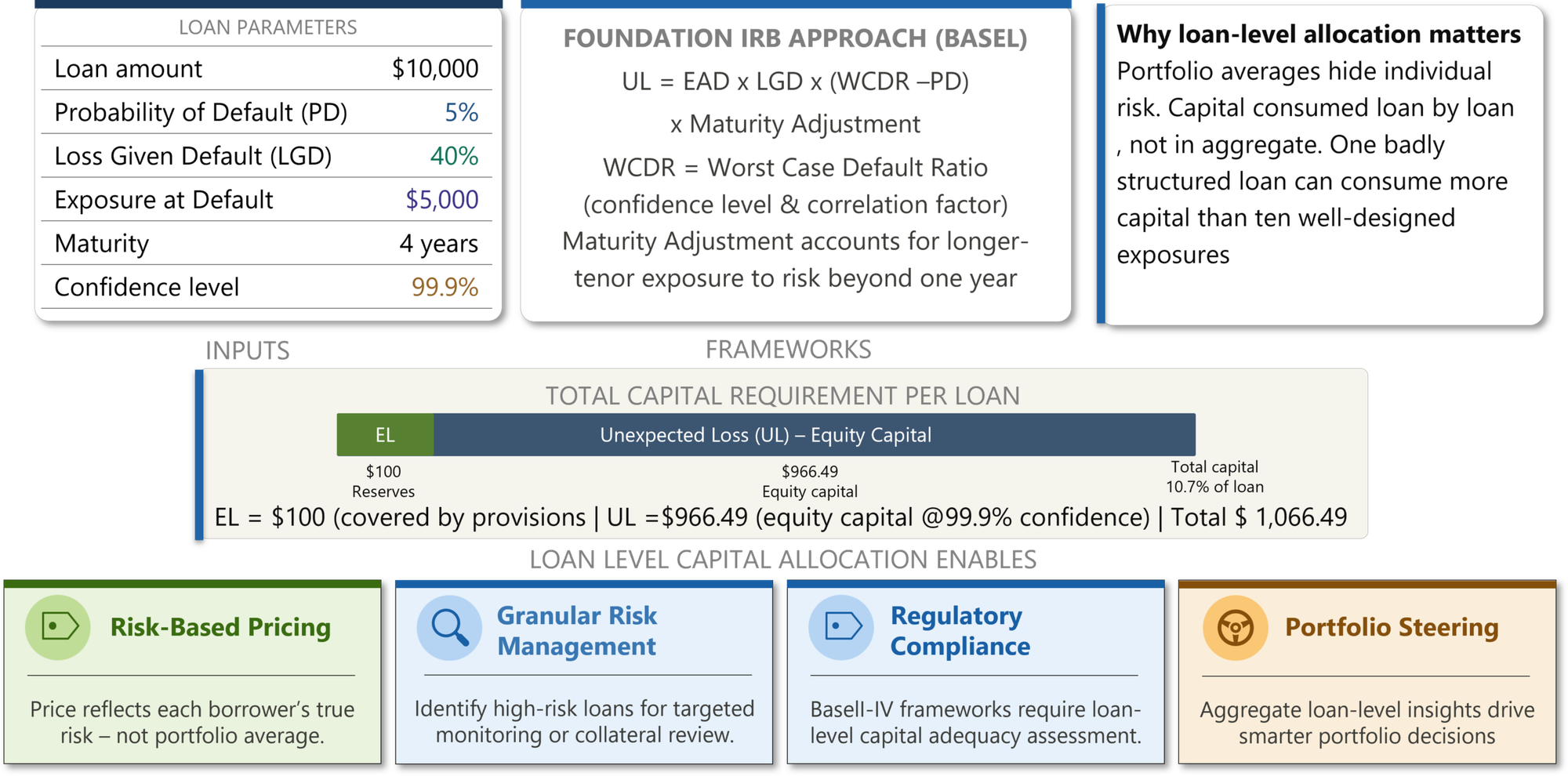
A loan with a higher PD, weaker collateral, and longer maturity may still be attractive, but only if the return compensates for the capital it consumes. Loan-level capital allocation exposes the true cost of risky structures that look attractive on the surface, the capital efficiency of well-secured, shorter-tenor exposures, the hidden cost of concentration, and the genuine pricing floor below which a loan destroys capital rather than creates value.
When these dynamics are visible, structuring suddenly matters. Collateral quality becomes economically meaningful. Pricing discussions become factual rather than positional.
Without loan-level capital visibility, institutions systematically overestimate profitability and underestimate volatility.
The Non-Linear Cost of Confidence
As confidence levels increase, capital requirements grow non-linearly: moving from 95% to 99% confidence requires additional capital, and 99% to 99.9% requires substantially more. This reflects the reality of loss distributions: extreme losses are rare but severe. Choosing a confidence level is a strategic decision about how much volatility the institution can and should absorb, inseparable from risk appetite.
An institution that wants to survive almost all scenarios must hold significantly more capital. An institution willing to accept higher volatility can operate with less. Neither is inherently right or wrong. What is dangerous is pretending that these decisions are neutral.
Capital Discipline Improves Lending Quality
When capital allocation is explicit and loan-level, institutions naturally improve the quality of what they originate: not by rejecting more deals, but because the economics drive better structuring.
Capital-aware institutions tend to shorten maturities where possible, negotiate stronger collateral structures, adjust exposure profiles to avoid concentration penalties, and decline transactions that look profitable but quietly destroy capital. This is risk intelligence, not risk aversion. Capital-aware institutions often gain market share in downturns while less disciplined competitors retreat.
Capital as a Steering Tool
The most sophisticated institutions use capital allocation to steer the business: identifying under-utilized risk capacity, rebalancing sector concentrations, adjusting growth targets dynamically, and linking strategy to resilience. Capital becomes the connective tissue between risk measurement, pricing discipline, portfolio management, and strategic ambition.
Q-Lana’s approach
Capital allocation is a core element of how Q-Lana builds lending platforms and supports advisory engagements. Every transaction in our platform is assessed not just for credit quality but for its capital consumption and contribution to portfolio-level risk. Capital is not a number reviewed quarterly, it is a variable visible in real time, at the point of decision. This reflects our belief that credit risk management is not a compliance function. It is a competency that should live at the center of an institution’s business model.
Q-Lana Knowledge Resources
White Paper: Credit Risk and Risk Appetite, Part 1 includes worked Basel IRB capital calculations and a detailed treatment of individual loan UL. Download at q-lana.com.
Q-Lana Financial Skills Campus (FSC): Class 1, Credit Risk Measurement and Capital. Covers Basel approaches, capital allocation at the loan level, and the relationship between confidence levels and capital requirements.
FSC Course: Portfolio Management and Capital Optimization, connecting loan-level capital discipline to portfolio-level steering and strategy.
About this Series
This article is part of Q-Lana's Five-part Credit Risk Management series, exploring how institutions move from intuition to a disciplined, measurable approach to credit risk, capital, and pricing.
The complete series includes:
- Credit Risk Starts with Measurement, Not Instinct
- Provisions Are Not Enough: Understanding Unexpected Loss
- RAROC in Practice: How to Separate Profitable Lending from Safe-But-Costly Deals
- Risk Appetite as the Operating System for Strategy, and this article.
Continue the Conversation
Talk to the team. Senior-to-senior. No sales call.
Subscribe to Q-Lana Weekly. One newsletter, five lenses, free, no paywall.
Read the related white paper. Frameworks built to be deployed.