Credit Risk Starts with Measurement, Not Instinct
This is the first article of the 5-part Credit Risk Management in SME and Corporate Lending series. We begin by showing why effective credit risk management starts with precise measurement, rather than intuition or anecdotal judgment.
Most lending institutions say they manage credit risk. Few actually measure it. Credit risk is the oldest risk in banking, and still the one most institutions struggle to manage consistently. Every lending institution understands the intuition: lend money, get repaid with interest, absorb losses when borrowers fail.
Yet when portfolios grow, markets turn, or stress hits the system, intuition breaks down. This article opens a five-part series on credit risk and risk appetite.
We start where every robust credit framework must start: the numbers that define what risk actually is.
A Note on Why This Series Exists
Credit risk management is a core competency at Q-Lana. It sits at the heart of everything we build, every advisory engagement we lead, and every institution we work with. Over years of working with banks, microfinance institutions, and development finance organizations across multiple markets, our team has observed the same pattern repeatedly: the concepts that determine whether an institution thrives or struggles over a credit cycle are not secret, not complex, and not reserved for the largest institutions. They are simply not taught clearly enough, or embedded deeply enough, in the day-to-day work of lending teams.
This Series is our Attempt to Change That
It accompanies our White Paper on Credit Risk and Risk Appetite, which is available for download on the Q-Lana website and provides the full analytical depth behind the concepts covered here. The White Paper is the third in our Thought Leadership Series, following our papers on Data Management and Customer Centricity in SME and Corporate Lending, and together they form a connected view of what responsible, modern financial institution management looks like.
For those who want to go further, these topics are also the foundation of two dedicated classes on the Q-Lana Financial Skills Campus (FSC): one covering credit risk measurement and capital, and one covering risk appetite frameworks. The FSC also offers a broader curriculum connecting these concepts to the practical, day-to-day work of credit risk management, from loan origination and pricing to monitoring, covenant management, and portfolio review.
Q-Lana Financial Skills Campus (FSC)
Why Intuition Breaks Down
In a small portfolio, experience and judgment can carry an institution far: a seasoned credit officer knows the borrowers, the relationships are real, the patterns are visible.
What We See Across Institutions
If you have read our work on Customer Centricity, you know that we are strong advocates of client proximity and the expertise of experienced lending professionals. That is not a contradiction to what follows. In fact, it is complementary. The best relationship managers combine client insight with analytical rigor, they see the individual borrower clearly and understand where that borrower sits within the broader portfolio picture.
What this series addresses is the scaling exercise: how institutions move from managing individual relationships to managing a portfolio, and from managing a portfolio to defining and steering their credit risk appetite.
The metaphor we use internally: the skilled credit officer looks at the trees. The role of credit risk management is to paint a picture of the forest.
Scale Changes the Nature of the Challenge
When portfolios grow, when borrowers become abstractions on a spreadsheet rather than faces across a desk, when economic cycles shift, intuition needs to be quantified. The decisions that felt sound in stable conditions must now be solidified into a framework that governs the overall portfolio and defines the institution’s credit risk appetite.
This is a failure of measurement. Risk begins with how uncertainty is measured, with losses.
The Language of Credit Risk: PD, LGD, and EAD
Modern credit risk management is built on three measurable variables that have been at the heart of the Basel regulatory framework for decades, yet many institutions still treat them as back-office constructs rather than front-line decision tools.
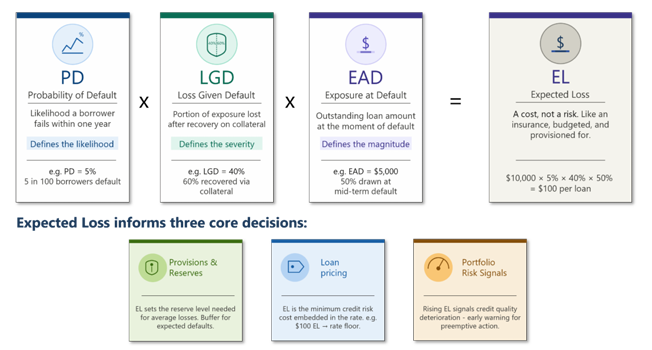
Probability of Default (PD): How likely is Failure?
PD answers a deceptively simple question: What is the likelihood this borrower will fail to meet their obligations within the next year?
A PD of 5% doesn't mean the borrower will default: it means among many borrowers with similar profiles, five in one hundred are expected to default over that horizon. This distinction is critical. PD is a statement about portfolio behaviour, and not a prediction about an individual.
Strong PD models reflect financial strength and cash-flow stability, business model resilience across cycles, sector sensitivity and macro exposure, and observed behavioural patterns over time.
When PD is poorly estimated, institutions systematically underprice risk and discover the cost only when defaults arrive in clusters.
The executive question
When did we last validate that our PD estimates reflect reality, not the last good year?
Loss Given Default (LGD): What Does Loss Actually Mean?
LGD measures the proportion of exposure that won't be recovered after default. It is where optimism does its most dangerous work:
- Collateral looks strong on paper
- Guarantees appear enforceable
- Recovery assumptions quietly ignore legal delays, property market cycles, and jurisdictional complexity.
- During a downturn, collateral values fall precisely when you need them most.
LGD is shaped by the quality and liquidity of collateral, legal enforceability and realistic recovery timelines, market conditions at the time of default (not origination), and seniority/structure of the claim. Two loans with identical PDs can have radically different risk profiles if their LGDs differ.
A secured loan with a higher PD may be safer in practice than an unsecured loan with a lower PD. LGD is where risk discipline meets operational reality.
Optimism is not a risk management strategy. LGD is where it gets exposed.
Exposure at Default (EAD): How Big Is the Problem?
EAD captures how much is actually at risk at the moment of default: the variable most consistently underestimated, particularly in revolving facilities.
For term loans, EAD declines predictably as principal is repaid; for credit lines, overdrafts, and guarantees, borrowers draw on available liquidity before defaulting, so covenants are often breached after exposure has already expanded.
EAD reflects:
- Product structure and utilization behavior
- The timing and sequencing of default within the credit lifecycle
- Contractual features that either limit or accelerate drawdown
Ignoring EAD dynamics leads institutions to believe they are less exposed than they are. The surprise arrives precisely when capital is most under pressure.
Putting It Into Practice
Three Variables. One Complete Picture.
Together, PD, LGD, and EAD answer the only question that matters: how much can we expect to lose, and what drives that number? Their product forms Expected Loss: the foundational metric for provisioning, pricing, and portfolio management. Their real power is structural: they create a common language across credit, finance, and risk functions for comparing decisions and steering growth deliberately.
Without these measures, risk discussions remain subjective. With them, risk becomes comparable, transparent, and manageable.
From Numbers to Decisions
Many institutions stop short here: PD, LGD, and EAD are modelled, filed, and reviewed annually by the risk team, but rarely reach the relationship manager making a pricing decision or the credit committee debating a structure. That is a strategic failure, not a technical one. These metrics exist to ensure growth is profitable after risk, capital is deployed where it generates returns, and early warning signals are visible before problems become crises.
Institutions that embed these measures directly into credit decisions do not take less risk: they take better risk.
Q-Lana’s approach
At Q-Lana, credit risk management is not a department function, it is a core institutional competency that runs through every product we build and every engagement we lead. PD, LGD, and EAD are not static inputs to a capital calculation. They are live variables embedded in origination, monitoring, pricing, and portfolio analytics, visible to the people making decisions, not just the team reviewing them afterwards.
Q-Lana Knowledge Resources
White Paper: Credit Risk and Risk Appetite, available for download at q lana.com. Part of Q-Lana’s three-paper Thought Leadership Series alongside Data Management and Customer Centricity.
Q-Lana Financial Skills Campus (FSC): Class 1, Credit Risk Measurement and Capital. Covers PD, LGD, EAD, Expected Loss, Unexpected Loss, and Basel capital frameworks in depth.
FSC Connected Curriculum: Courses on loan origination, risk-based pricing, and credit analysis that connect these concepts to everyday lending practice.
About this Series
This article is part of Q-Lana's Five-part Credit Risk Management series, exploring how institutions move from intuition to a disciplined, measurable approach to credit risk, capital, and pricing.
The complete series includes:
- Provisions Are Not Enough: Understanding Unexpected Loss
- Capital Is a Signal, Not a Constraint
- RAROC in Practice: How to Separate Profitable Lending from Safe-But-Costly Deals
- Risk Appetite as the Operating System for Strategy, and this article.
Continue the Conversation
Talk to the team. Senior-to-senior. No sales call.
Subscribe to Q-Lana Weekly. One newsletter, five lenses, free, no paywall.
Read the related white paper. Frameworks built to be deployed.