
Discipline is the most ethical thing an impact lender can offer
Impact funds that survive do so by making disciplined loans. Learn four habits: know your loss budget, price for the risk, limit losses on loans that go bad and keep first-loss capital for the bad year. Then test them in our free model.
Lend with discipline, then your impact fund can keep serving its borrowers and deliver on its mission for years. Discipline takes four simple forms:
- know how much loss you can absorb so that the fund operates sustainably
- price each loan to the inherent risk
- limit losses on any individual loan, and
- save the protective capital for what it is meant to protect, such as the really bad year or the unexpected events, rather than using it up bit by bit.
Each of these habits protects: investors keep their capital. Board and sponsors keep their promises. Credit teams get clear rules to work with. And the farmers and small businesses the fund exists for, see you as a reliable partner to work and grow with.
This article explains what pulls impact funds away from these habits. It then shows a fund that runs out of protection in under five years, and what to do to rescue it.
You can follow the calculations and the efforts to improve with Q-Lana's free Impact Fund Credit Risk Model. Ways to reach our team and take the topic deeper are given below.
What Makes it Hard to Lend With Discipline
A good story can lower the bar
We have seen an impact fund's investment teams get "spoiled" by social outcomes. Not maliciously. Not stupidly. Humanly. The deal ticked the impact boxes and everyone wanted it to go ahead.

The usual checks became negotiable:
- the plan for repaying the loan was vague ("the sector will grow")
- borrower reporting was pushed back ("we'll build capacity later")
- covenants, the promises a borrower makes in the loan agreement, were written but never checked
- collateral looked fine on paper but couldn't be enforced
- conditions precedent, the steps a borrower must complete before money is released, were waived as "inconvenient"
- the loan was priced like ordinary credit, though its risk was significantly higher, comparable to an equity style transaction
When the borrower later struggles, the review points to volatile markets, country risk or a sudden shock. Sometimes, that is true. Often, the cause is closer to home. The fund backed an impact story with a structure that couldn't pass a basic stress test. A weak deal costs more than its own losses, it shrinks what the fund can lend to the next borrower, who might have done well, and it harms the long term goal to show economic viability in the businesses that are financed.
Lenders can lose far more than they earn
A loan has a ceiling on what it can earn. At best, the lender gets its money back with interest. If the business does brilliantly, its owners share the gain and the lender still receives only the agreed interest.
Here is the arithmetic.
Lend $100 at 10%. If the borrower repays, you earn $10. If they default and you recover half, you lose $50. One loss wipes out five good outcomes, and managing that gap is the lender's whole job. And that calculation is even before cost of funding or operating expenses.
Therefore, when a loan carries risks beyond what was priced in the interest rate, the portfolio is set up to lose money. In impact finance, those losses carry negative consequences on people. They mean less lending next year. The fund's own target borrowers feel it first. That is why disciplined lending is the ethical choice for an impact fund.
Concessional money can lead to softer lending
Many impact funds include concessional money, meaning funding on softer terms from donors or development finance institutions. It often comes with a dangerous sentence: "We can take more risk because there's concessional funding." In reality, the logic should run the other way.
Concessional money is meant to attract commercial investors and prove that a sustainable funding model can be established. If done well it builds lenders that can serve the same borrowers sustainably and without subsidy. When it leads a fund to relax its standards, losses climb and weak deals are signed. Borrowers learn that rules bend, commercial investors grow wary, the fund's mission fails and potentially even harms the reputation of the industry.
Development finance institutions agreed on this years ago. Their Enhanced Principles for Blended Concessional Finance ask for no more subsidy than a deal needs. They also warn against crowding out commercial investors. The GIIN's brief on catalytic first-loss capital adds a further warning. Protection can encourage careless lending, distort markets and outstay its purpose because nobody wants to remove it.
Equity risk can hide inside a loan
A common pattern is equity risk funded with a loan. Repayment depends on:
- growth that hasn't happened yet
- profit gains nobody has proven
- a refinancing, or a new investor arriving
- a new export market opening up
- perfect delivery by a stretched team
Those are an equity investor's assumptions. They can be sensible when you invest with equity tools and an equity time frame. Put them inside a loan that must be repaid first, and the pieces stop fitting. The borrower is pushed into growth bets while the lender holds the downside. Nothing in the structure manages the swings, and the price doesn't cover the uncertainty.
When this fails, people call it impact risk. In reality, it is the wrong tool for the job. A loan needs a way to be repaid that doesn't depend on heroics.
A Fund Before and After it Learns to Lend with Discipline
A fund that looks well protected

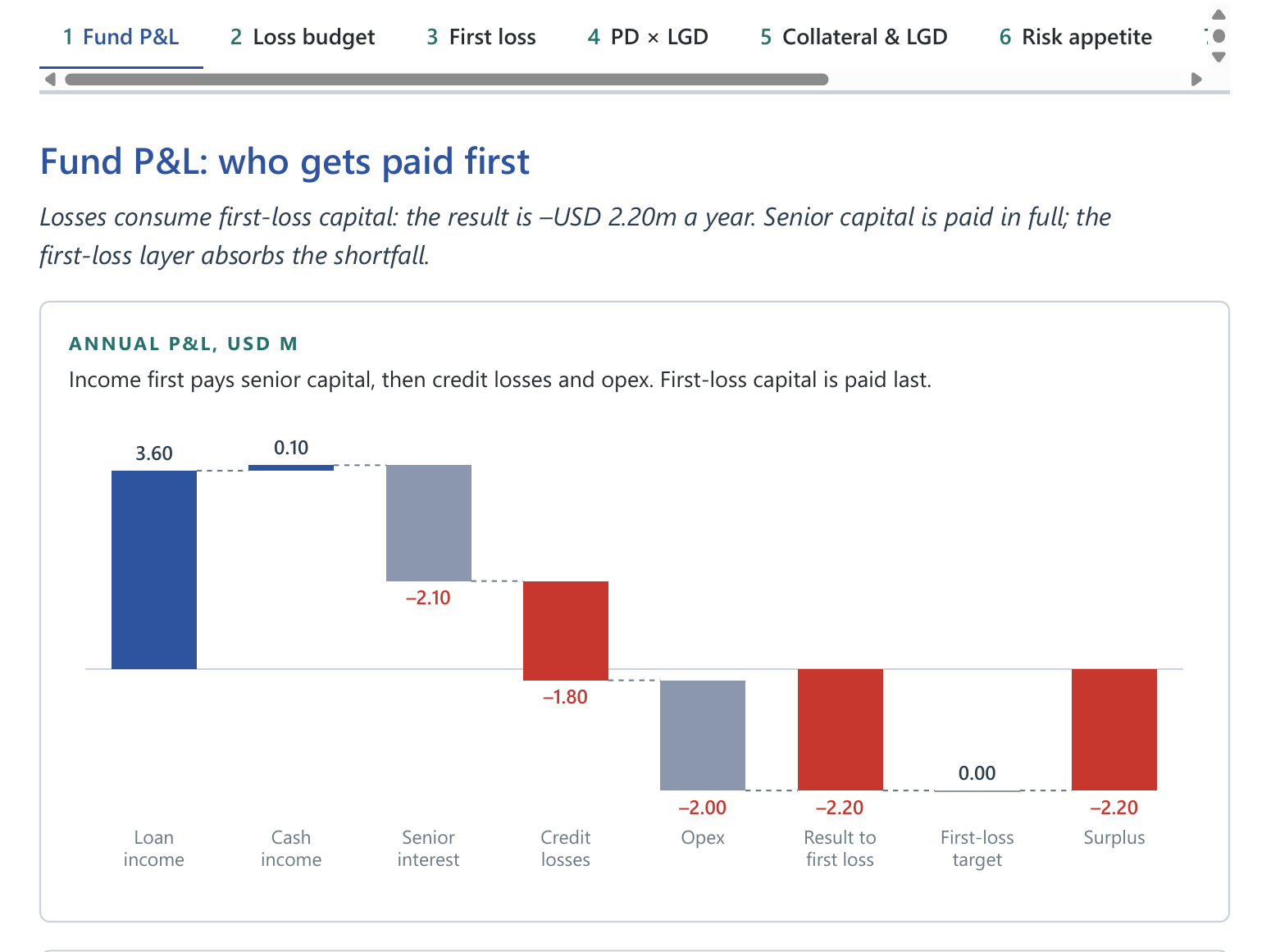
To document our case, we have developed a financial model for impact funds. You can download it below. We look at a hypothetical fund: it holds $10m of first-loss capital, money that takes the first hit and expects no return. It also has $3m from senior investors, who are paid first and earn 7%. It lends at 10%, keeps 10% of its money in cash and spends $2m a year to operate. We assume a 10% default ratio and expect that half of what's owed in those defaults is recovered (after cost and time). That's a fair picture of lending to small businesses in tough markets.
On paper, the fund looks safe. A quarter of its capital is there to absorb losses, so the senior investors feel secure.
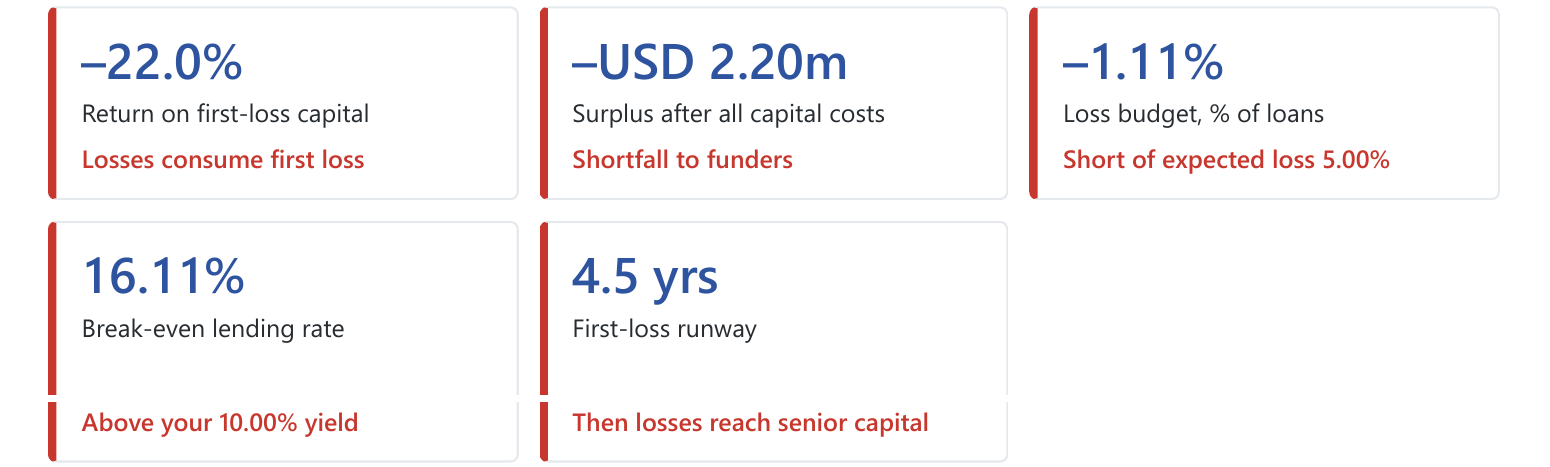
Yet the numbers show a loss of $2.2m a year. The first-loss money soaks it up quietly, year after year. At that pace, it's used up in four and a half years. Then the senior investors who were promised protection start losing money. Nothing dramatic happened. The fund simply took on more risk than its structure could pay for.
The concession also costs more than it seems. Suppose a commercial investor would want 12% for carrying that first-loss risk. Then the true subsidy is the 1.2 million of return given up, plus 2.2 million of absorbed losses. That is 3.4 million a year, and the people providing the money rarely see that figure.
Two changes that save the fund
There are ways to correct the situation. Several variable can be adjusted. The first and most important step is around the credit losses. Innpact funds tend to take higher risks, as expressed in the 10% default ratio but it is imperative to minimize the actual losses of those defaults by optimizing the access to the borrower's cash and the collateral. At a 10% default ratio and a loss given default of 25% instead of 50%, total cost of credit risk reduces to 2.5%. The second obvious lever is that of the borrowing rate. In an environment where a fund pays 7% to its senior lenders, an interest rate of 14% seems more adequate for its borrowers.
The fund, the first-loss money and the borrowers all stay the same. Yet, now the fund pays its senior investors, covers its costs and never touches the first-loss money. That cushion stays put for the bad year that will eventually come.
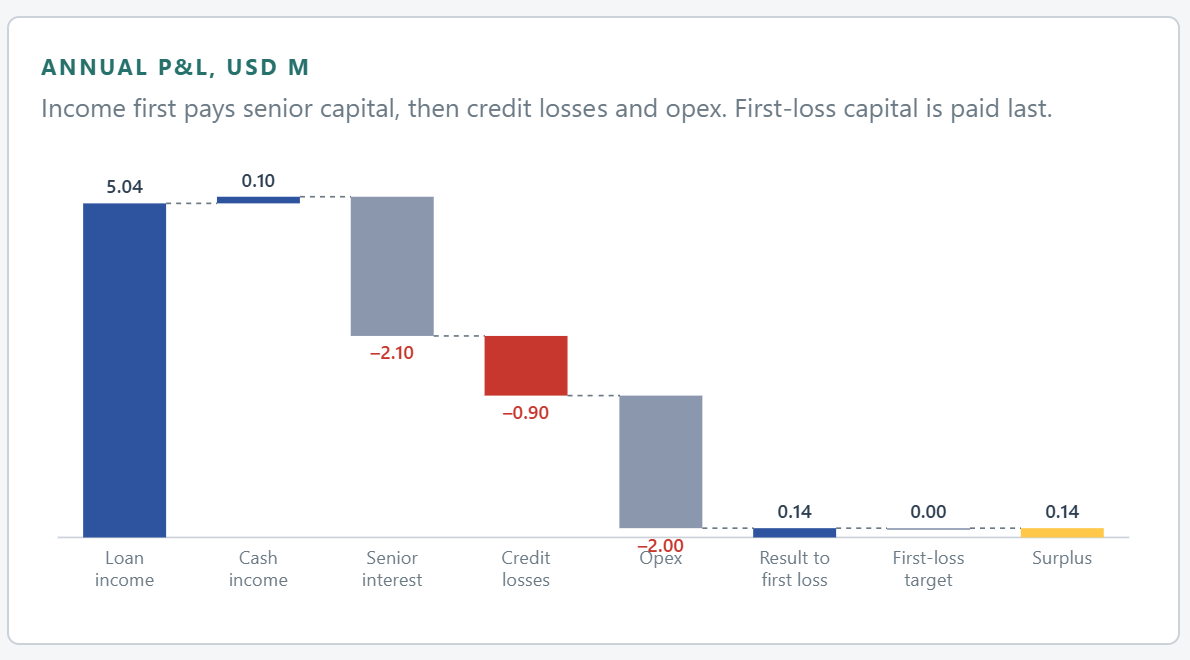
In the first version, first-loss capital props up the fund every day. In the second, it waits for trouble, and it lasts.
How to Lend With Discipline, Step by Step
Know your loss budget
To lend with discipline, start with one number. Every lending fund has a loss budget, even if nobody has calculated it. Start with the interest from loans and add the interest on cash. Then subtract what senior investors are owed, the running costs and any return the first-loss money expects. What remains, per unit lent, is the most loss the fund can expect to absorb.
Expected loss is the chance a borrower stops paying, multiplied by the share of the loan you then lose. Credit teams call these the probability of default and the loss given default. Our guide to expected loss in credit risk shows the calculation step by step. With 10% of loans defaulting and half of each one lost, the fund loses 5% of its loans every year.
Two critical lessons follow.
- Every point of expected loss lands on the borrower's interest rate. Take the model's base case A fund with an expected loss of 5%, e.g. resulting from a 10% default probability and a 50% recovery needs to charge a client rate of 16.11% just to break even. In a debt fund, the borrowers who repay end up covering those who don't. Our article on risk-adjusted return on capital shows how price, risk and capital connect.
- One bad loan takes many good ones to repay. Divide the loss on a failed loan by what each good loan adds to the loss budget. In a scenario of a 10% client interest rate and a loss given default of 50%, one defaulted loan consumes the interest revenues of 5 performing loans. And that calculation is before considering funding or operating expenses akes dozens.
Keep the loss small when a loan goes bad
An impact fund is usually prepared to take higher risks. It can even accept more defaults, as long as each one costs less. This requires the discipline to measure, price and control the risk. Things lower that cost are for example control over the borrower's cash or collateral that is enforable. Cut the loss on each default from 50% to 25%, and the fund can afford twice as many defaults .
Use local knowledge
Money that crosses borders often travels faster than an understanding of where it lands. A lender needs to know how courts work in practice and how long collateral really takes to recover. It needs to know which informal claims sit on assets, and how politics and paperwork delay recoveries. It should also understand how cash can be moved or hidden, and what local reputation is worth. The evidence supports this. A Dalberg study for CSAF and USAID examined lending to small farm businesses in East Africa. Yearly credit losses ranged from 3.2% to 5.4%, depending on the type of lender. Local lenders with a specialist agriculture team lost about 3.6% a year. Those without one lost about 6.2%. Global social lenders lost 4.6% on loans under USD 500,000 and 3.1% on larger ones.
Specialist knowledge and closeness to borrowers are among the best protections a fund can have. They make it far easier to lend with discipline. Without them, losses get blamed on country risk. Often the real cause was a gap in knowledge.
Make concessional money raise your standards
Concessional money should make a fund stronger. It's scarce, and the people who provide it deserve a fund that endures. Used well, it pays for:
- longer loan terms where the market only offers short ones
- sharing specific, well-understood risks such as currency swings, first losses or political events
- time to prove an operating model or an investment strategy that that can later stand on commercial terms
Concessional money should never be the permission to:
- skip the plan for how the loan gets repaid
- accept covenants nobody can check
- waive key conditions before money is released
- count on collateral that can't be enforced
- charge a loan price for the uncertainty of an equity investment
Spot warning signs early
The weaknesses behind a bad loan can usually be identified even before an actual default occurs. Some typical signals are:
- repayment dates that don't match when the borrower actually earns money
- covenants that can't be checked, or never are
- conditions before release waived early and often
- no real control over the borrower's cash
- collateral taken for show rather than enforcement
- reporting requirements with no consequence when they're missed
Catching them early leaves time to act. A loan that started badly can almost always be restructured. That usually means better support for the borrower and longer-lasting impact for the fund's investors.
Test How Well Your Fund Can Lend With Discipline
We built the Impact Fund Credit Risk Model so you can see all of this with your own numbers. It's free and runs in your browser on the Q-Lana tools website. Nothing you enter is stored.
Open the Impact Fund Credit Risk Model
The model is deliberately simple. It shows one year in a steady state and assumes invested money earns for the whole year. It leaves out timing, currency, tax and provisioning. Use it to understand how a fund works, not to forecast yours.
Five things to try when using the model
- Find your loss budget. Enter your fund's cost of funds, yield and operating costs. Compare the loss budget with the expected loss your credit team expects.
- Watch the first-loss runway. Add senior capital in steps. See how fast expensive borrowing eats into the room for losses.
- Weigh defaults against the loss on each one. In the heatmap, find the combinations that keep the first-loss layer intact. Then ask which ones your collateral and cash control can deliver.
- Build one loan. In the collateral tab, switch cash control on and off. Then reduce the chance your security can be enforced, and see which change matters most.
- Break it. Run the stress test with a sovereign and currency crisis, then with one large default. Find the point where losses reach senior capital.
How Q-Lana Helps You Lend With Discipline
While we make the fund model available for you at your own discretion. We also like to make sure you are not left alone with open questions to ensure that your impact fund operates profitably and within its mission. As you test the model. Please reach out to us, and we can help you working on critical questions about your fund, including:
- What is the fund's loss budget, in numbers?
- How many years of expected loss does you first-loss layer cover?
- How can we strengthen your fund's risk profile so that expected losses reduce to acceptable levels.
At Q-Lana, we help you in several ways.
- Model the fund you actually run
The free model is simple by design. We tailor it to your portfolio, using your cost of funds, capital structure, defaults and recoveries. You get a loss budget, a first-loss size tested under stress, and minimum prices for each product. Your investment committee and investors can see and question every figure. We can also review your risk appetite and investment strategy against your goals.
- Run the fund on a platform with discipline built in
Q-Lana's loan and asset management platform manages every loan from application to recovery. It turns the habits in this article into everyday practice:
- risk limits and concentration checks applied when a loan is made, not reviewed afterwards
- a structured credit memo recording the repayment plan, the main risks and the conditions before release
- covenants that are defined, scheduled and checked, with breaches flagged and escalated
- collateral, cash control and enforcement tracked for each loan, so the loss on default is measured
- portfolio monitoring of arrears, expected loss and concentrations against the board's approved loss budget
- a single record of every loan, decision and recovery, so the fund learns from its own history
- Build your team's judgment
The Q-Lana Financial Skills Campus trains credit and investment teams in the methods behind this model. Courses cover risk thinking, covenant design, early warning and risk appetite frameworks.
Talk To Us About Your Fund
Every fund’s numbers tell a different story. If you’d like to know what yours say, Christian and the team will go through them with you.
Test your fund in the free model
Enter your fund’s figures in our free Impact Fund Credit Risk Model. In ten minutes, you’ll see how long your cushion lasts and what your loans need to earn. Nothing you enter is stored. Username: Public_User (or publicuser@q-lana.com). Password: Blog@2026).
Book a call with a practitioner
Bring your fund’s numbers and leave with your loss budget, your first-loss runway and the price your loans need. You’ll talk to someone who has run lending funds, not a sales team.
Ask us anything about your numbers
Stuck on a result in the model, or a deal that doesn’t add up? Email us and a credit specialist will reply.
Follow Christian on LinkedIn
Christian shares lessons from decades of lending in emerging markets. Comment on this article and he’ll answer.
Get Q-Lana Weekly
One short email a week on credit risk, lending and impact finance, free. Or browse more practical guides in the Q-Lana Knowledge Center.
Keep learning.
Free white papers on credit risk, customer centricity and data management are in the Q-Lana Knowledge Center.